In the field of biopharmaceutical manufacturing, the micronization of active pharmaceutical ingredients (APIs) and biomaterials is a critical step that determines the performance of the final formulation. The particle size, crystalline form, and fluidity of raw materials directly influence drug solubility, absorption rates, and clinical efficacy within the human body.
For pharmaceutical procurement professionals and supply chain managers, every raw material processing step carries the weight of regulatory auditing and product reputation. A certified pharmaceutical ball mill is not just a piece of machinery; it is the gatekeeper of production line GMP compliance. Here is a technical breakdown of how conventional ball mills deliver transformative, compliant results across four critical B2B application scenarios.
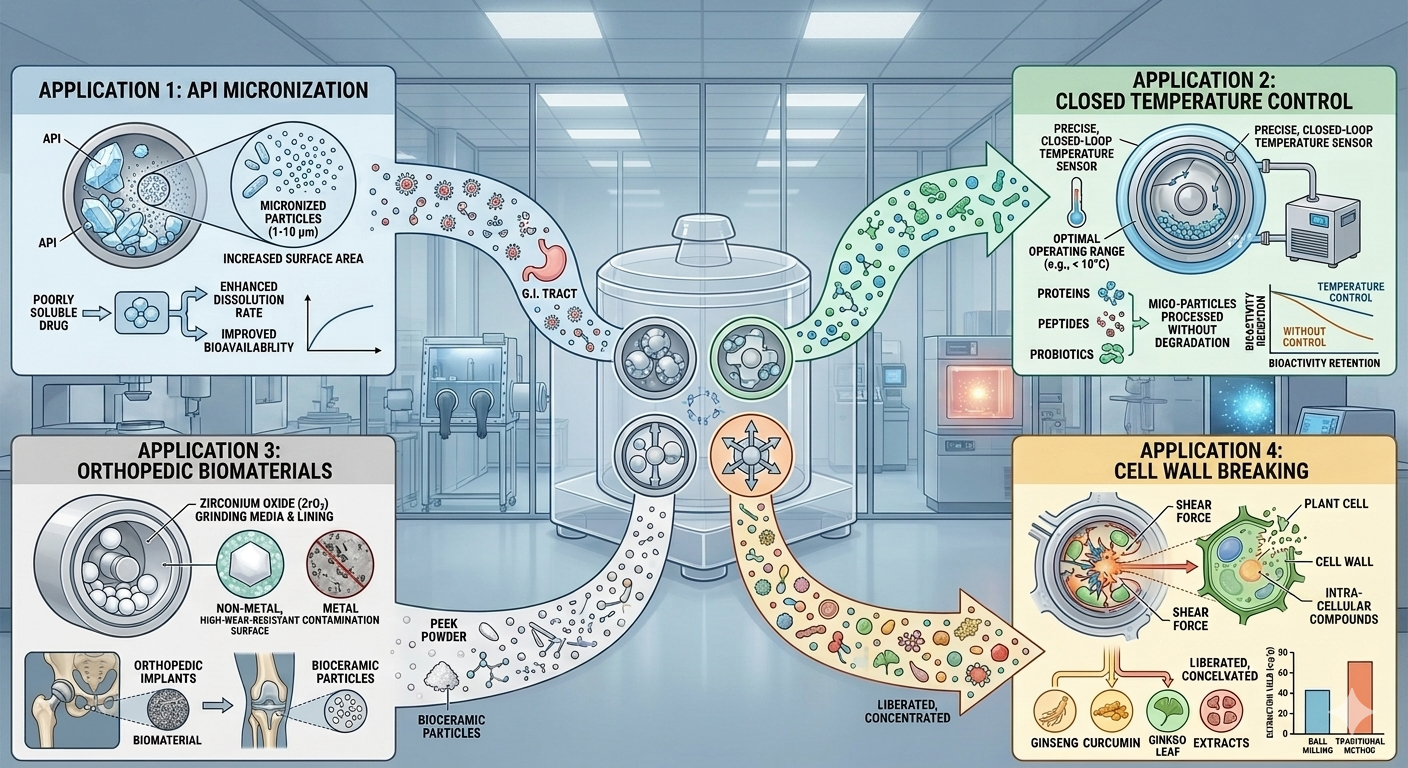
1. Poorly Soluble Targeted Chemical Drugs: API Micronization
Many innovative small-molecule chemical drugs targeting cancer or chronic diseases belong to BCS Class II or IV, meaning they are extremely poorly soluble in water. When taken orally, the drug crystals fail to dissolve rapidly in the gastrointestinal tract, resulting in low bioavailability and material waste.
- The Technical Process: Hydrophobic raw materials are introduced into the grinding chamber together with specific hydrophilic excipients, utilizing high-density, medical-grade zirconia or tungsten carbide grinding beads for dry or wet co-milling.
- Engineering Solution: The ball mill drives the grinding media via high-speed rotation, applying continuous high-energy mechanical impact and shear forces. This force breaks down the inherently rigid lattice of the API, achieving ultra-fine particle sizes and uniform, molecular-level blending. The excipients form a physical barrier to inhibit agglomeration and vastly increase the specific surface area.
2. Thermosensitive Bioactive Substances: Enclosed Thermal Management
For certain relatively stable biomacromolecule powders, excipients for microecological formulations, or naturally extracted small-molecule active peptides, traditional jet mills pose severe challenges. They easily cause raw material loss due to high wind speed and dust, alongside high risks of cross-contamination.
- The Technical Process: Closed-loop ball milling is conducted utilizing integrated water-cooling jackets or ambient air-cooling systems to perform completely isolated material processing.
- Engineering Solution: Circulating cooling water within the jacket timely removes the physical heat generated by bead friction, stabilizing the internal chamber temperature within a safe range. In the completely sealed grinding jar, materials undergo gentle yet intensive mechanical milling. This swiftly homogenizes the ingredients into micron-sized powders without altering their chemical structures, while preventing clumping caused by heat-induced moisture.
3. Orthopedic Repair and Implant Biomaterials: High-Purity Processing
In the sectors of orthopedic implants and hard tissue repair, the inorganic structure and purity of artificial bone and bone cement materials (such as hydroxyapatite and β-tricalcium phosphate) are paramount. These hard mineral materials are not only highly abrasive but also extraordinarily sensitive to metal impurities.
- The Technical Process: Ball mills are strictly configured with specialized non-metallic liners—such as polyurethane, nylon, or zirconia linings—and high-wear-resistant ceramic grinding beads of matching materials.
- Engineering Solution: Utilizing the powerful gravitational drop and centrifugal force impact of the ball mill, hard inorganic non-metallic materials are continuously pulverized down to sub-micron scales. This setup completely eliminates mechanical wear impurities like iron, chromium, and nickel at the source, preserving the chemical purity and excellent biocompatibility of artificial bone materials.
4. Traditional Medicine and Natural Active Extracts: Cell Wall Breaking
Natural products such as ginseng, flavonoids, saponins, and Ganoderma lucidum spore powder hold their core active components locked deeply inside resilient plant cell walls. If these cell walls remain intact, the efficiency of subsequent chemical solvent extraction processes will be extremely low, wasting large volumes of solvents.
- The Technical Process: High-frequency vibration or planetary conventional ball mills are employed to apply high-density mechanical forces to dried plant tissues or crude extracts.
- Engineering Solution: Internal grinding beads move at high frequencies within a three-dimensional space, creating a high-density rolling shear zone. This energy acts like micro-scissors to continuously compress and shear resilient plant fibers and cell walls. Once the cell walls are thoroughly disrupted, the intracellular active substances are directly exposed, allowing downstream solvents to rapidly dissolve the effective components.
Reliable Industrial Cornerstone for Pharma Production
Through optimized equipment configurations—such as metal-free contamination liners, high-precision micro-grinding media, and water-cooling modules—conventional ball mills fully satisfy rigorous GMP requirements regarding raw material stability, purity, and particle size distribution. Every bearing, every lining, and every grinding bead is engineered to serve as a dependable industrial cornerstone, safeguarding the exceptional quality of your biopharmaceutical products from the particle up.