
English
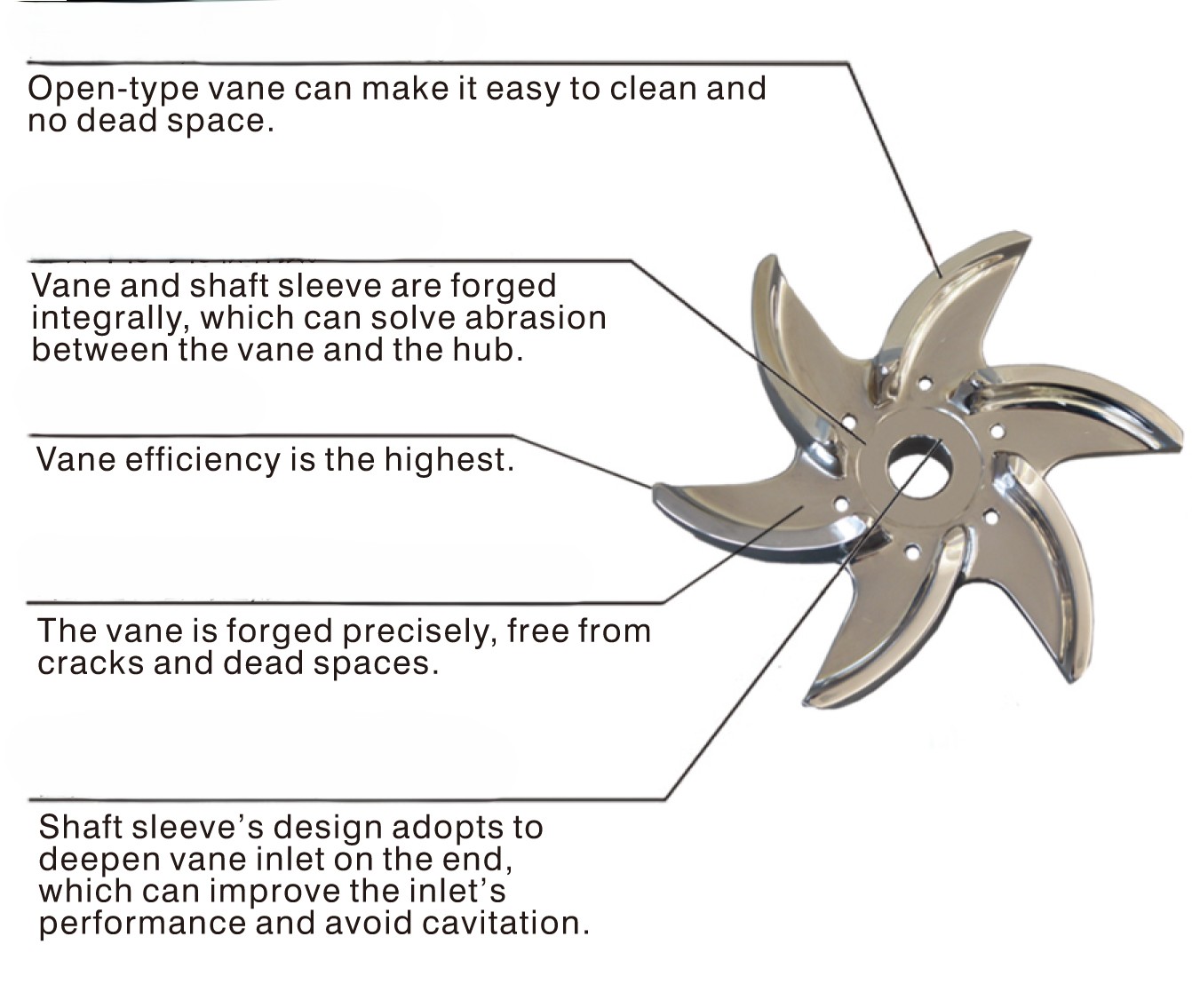
In high-purity fluid processing, centrifugal pumps are evaluated not just by hydraulic output, but by cleanability. For sanitary and hygienic applications—such as cosmetics, pharmaceuticals, and biotechnology—the impeller geometry acts as a critical process control variable. Traditional closed impellers rely on front and back shrouds that trap product residue, but sanitary centrifugal pumps utilize an open impeller design. The underlying engineering principles of open impellers eliminate microbial risks, optimize fluid mechanics, and ensure process security.
The operational superiority of an open impeller stems from its exposure to the internal pump casing. In a closed design, fluid becomes trapped in the close-clearance areas between the rotating shrouds and the stationary casing, creating stagnant zones. An open impeller features vanes attached directly to a central hub, exposing the entire flow channel to the liquid stream.
As the impeller rotates, it imparts kinetic energy through a continuous, sweeping action. This action creates high-velocity fluid paths across every internal surface. The liquid flow flushes the pump chamber, preventing chemical compounds or organic substrates from adhering to the metal substrate.
To meet global hygienic standards like 3-A and FDA, pump internals must be free of geometric dead spaces. Standard impellers often feature multi-piece construction where vanes are welded to backplates, leaving microscopic crevices. High-end open impellers resolve this via advanced metallurgy: they are integrally forged and machined from solid 316L stainless steel bar stock.
This single-piece construction eliminates joints, pores, and micro-cracks. Coupled with electropolishing to a surface roughness of Ra ≤ 0.4 μm, the open design provides full visibility and physical access. Liquid sanitizers during Cleaning-in-Place (CIP) cycles hit all product-contact areas directly, without encountering sheltered zones where bacteria form protective biofilms.
Cosmetic and biological fluids often contain shear-sensitive emulsions or surfactants prone to foaming, such as micellar waters or lotions. Open impellers provide a gentle energy transfer compared to positive displacement pumps or high-shroud closed impellers.
By eliminating the tight tolerances between shrouds and walls, the open design reduces local shear stress gradients. Furthermore, open vanes handle entrained air and micro-bubbles more effectively than closed variations. Gas pockets pass through the open flow path without accumulating at the impeller eye, which prevents air binding, maintains steady discharge pressures, and prevents downstream foaming.
Modern sanitary open impellers incorporate specialized component modifications to improve operational longevity. Integrating the vane and shaft sleeve into a single, precision-machined assembly prevents rotational abrasion and fretting corrosion between the hub and shaft.
Additionally, engineering the hub with a deepened vane inlet design optimizes the net positive suction head required (NPSHr). This specialized profile guides fluid into the eye of the impeller smoothly, minimizing structural turbulences, reducing local pressure drops, and preventing cavitation—the primary cause of mechanical erosion and batch contamination in high-purity processing.