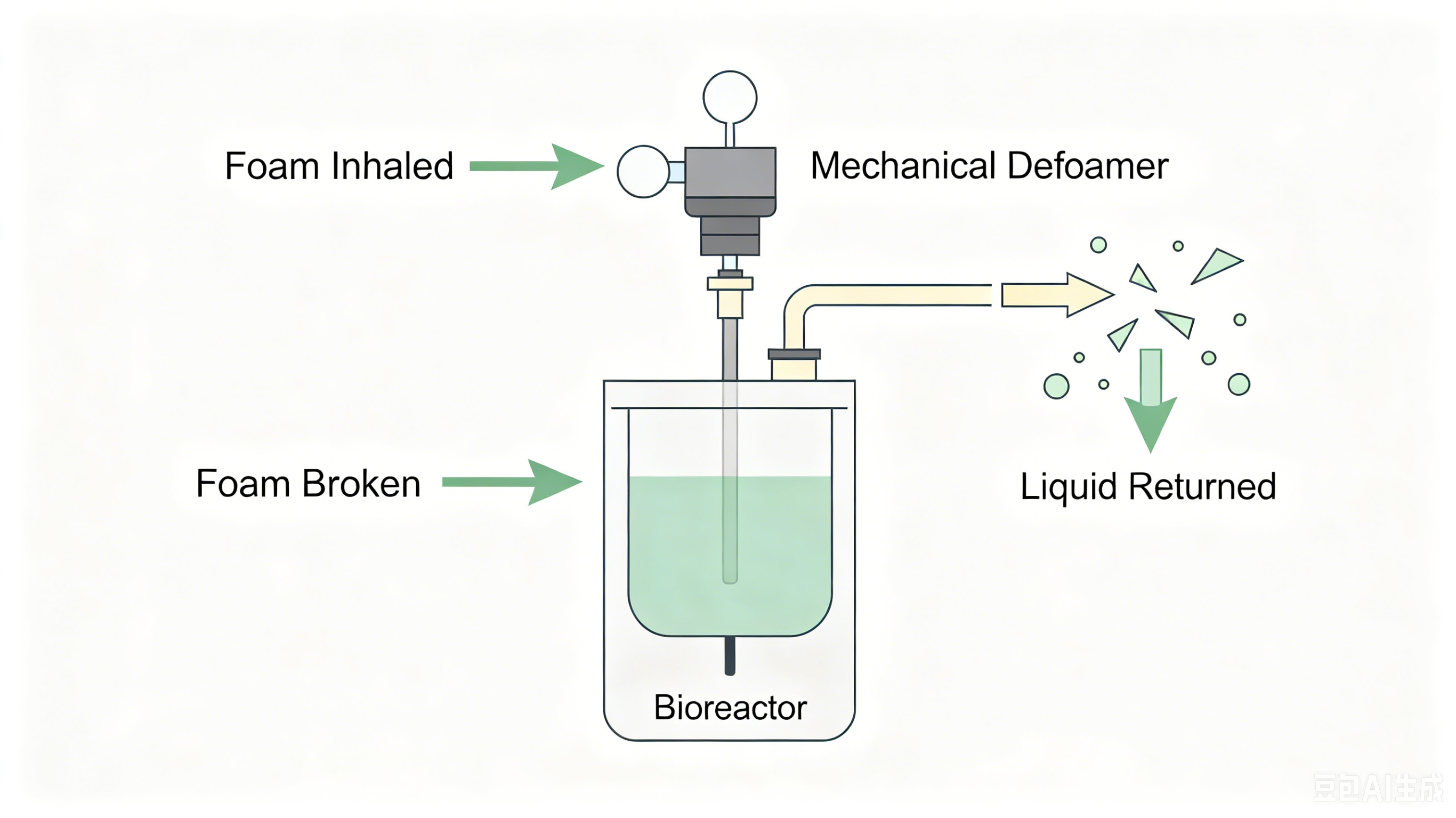
As a seasoned manufacturer of open-tank mechanical foam breakers and sealed mechanical defoamers, I have witnessed firsthand the transformative impact these systems bring to bioreactor operations. Your facility, like many others, is likely pushing for higher yields, faster batch cycles, and lower operational costs. Yet, a silent enemy keeps your production capacity hostage: foam.
You might be pouring chemical antifoams into every batch, believing it is the only way. But the very chemicals you rely on are actually shrinking your usable volume, choking your oxygen transfer, and clogging your downstream lines.
Let me walk you through this hidden compromise and show you how a physical upgrade can unlock your plant's true potential.
The Hidden Cost of Chemical Antifoams
Every time you dose a chemical antifoam, you are forced to reserve a massive headspace as a safety buffer. Because chemicals take time to work, operators dread the sight of foam spilling over the vents. This empty headspace is wasted potential. It is capacity you paid for but cannot use.
And that is just the beginning of the chemical penalty:
- Choked Oxygen Transfer: Chemical agents change the surface tension of your broth, causing oxygen bubbles to merge into larger, inefficient globs. Your oxygen transfer rate (OTR) drops, forcing you to slow down feeding rates and extend batch cycles.
- Downstream Purification Bottlenecks: Silicone residues and synthetic surfactants carry over into harvesting lines. They foul filtration membranes and clog chromatography columns, adding hours of tedious cleaning, maintenance, and premature replacement costs.
The Mechanical Advantage: A True Capacity Multiplier
Now, picture a different scenario. A mechanical defoamer—what we call a mechanical foam breaker—installed directly on your bioreactor flange or exhaust line. This is not just an auxiliary tool; it is a structural capacity multiplier.
Using high-speed centrifugal kinetic energy, the equipment instantly shreds foam back into distinct liquid and gas phases. The pure liquid is spun back down into the culture broth, while the clean gas vents safely.
- Reclaim Wasted Space: No waiting for chemical reactions means that massive safety headspace vanishes. You can safely fill your bioreactor closer to the top, unlocking extra working volume without buying a single new tank.
- Optimize Mass Transfer: Without chemical surfactants coating every bubble, your broth maintains optimal surface tension. Air bubbles remain small and numerous, maximizing the surface area for oxygen transfer. Your microorganisms breathe better, grow faster, and reach higher cell densities. Batch times shrink.
- Protect Downstream Throughput: Since no chemical agents are introduced, your harvested broth remains pure. Your membrane filters last significantly longer and your chromatography columns stay unclogged, accelerating your overall production throughput.
Engineering Standards for High-Purity Facilities
When selecting your mechanical defoaming equipment, it is vital to partner with a manufacturer who understands the strict compliance requirements of biopharma and food-grade fermentation. Purity is non-negotiable.
Our mechanical defoamers are built from the ground up with the following engineering standards:
- Hygienic Materials: Heavy-duty Stainless Steel 316L with mirror-polished surfaces to prevent microbial attachment and biofilm formation.
- Total Sterility: Fully compliant with CIP (Clean-in-Place) and SIP (Sterilize-in-Place) protocols, ensuring zero cross-contamination between batch rotations.
- Flexible Integration: We design top-mounted in-vessel defoamers for new reactor builds to optimize headspace from day one. For retrofitting existing lines, we manufacture external pipe-line foam breakers that seamlessly install onto your exhaust or recirculation circuits.