
English
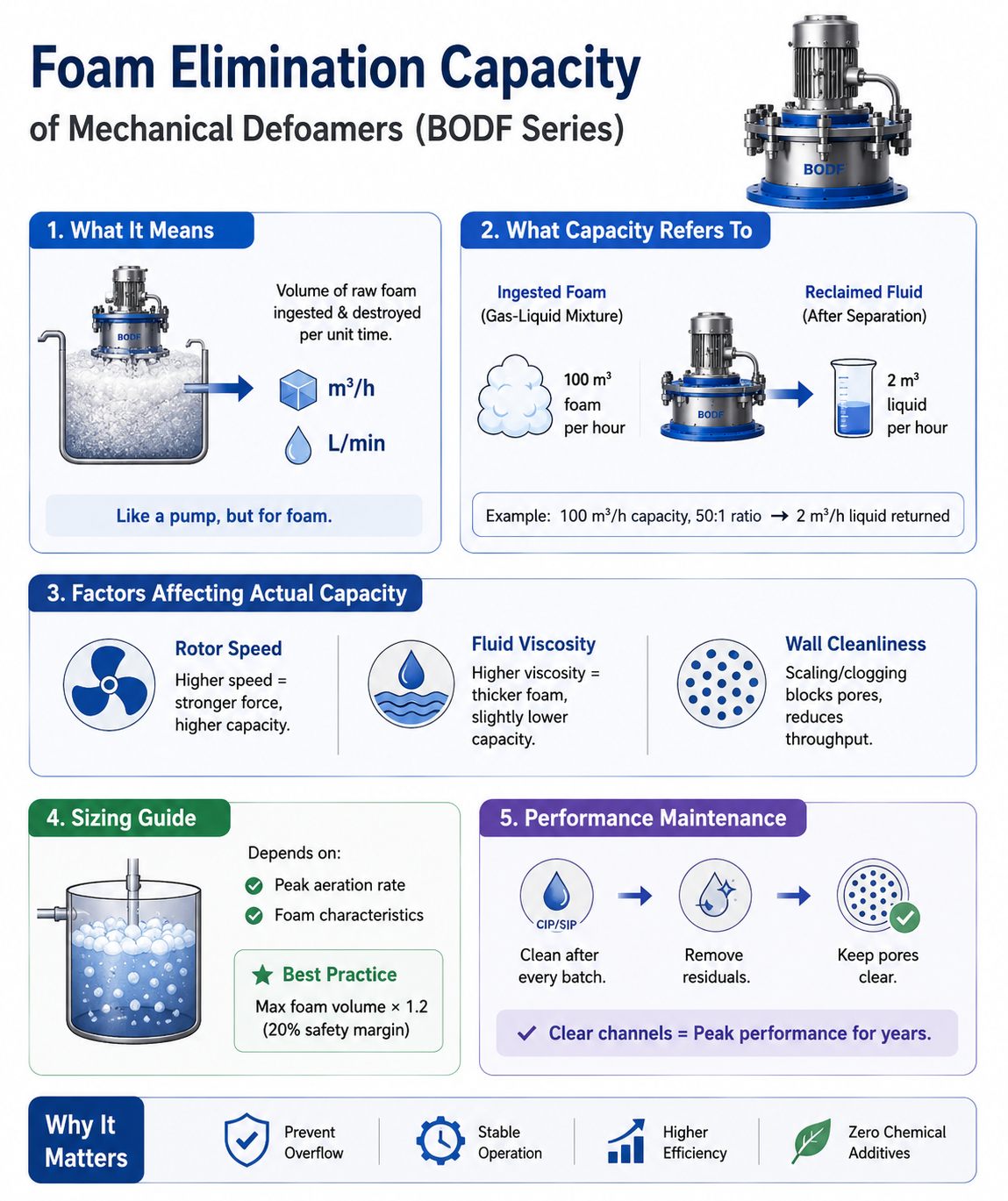
As a seasoned manufacturer specializing in Open-Tank Mechanical Foam Breakers and Sealed Mechanical Defoamers, I understand that when you evaluate equipment, you need more than just a spec sheet—you need a clear, pragmatic understanding of what drives real-world performance. Let’s take a hard look at the core capability that makes or breaks your process: Foam Elimination Capacity.
What Does Foam Elimination Capacity Really Mean? Simply put, this is the total volume of raw, fluffy foam that a dynamic centrifugal foam separator can ingest and destroy within a specific unit of time. Unlike chemical defoamers measured by ppm dosage, a mechanical foam breaker is rated by volumetric throughput. The standard engineering units are cubic meters per hour (m³/h) or liters per minute (L/min). Think of it like the flow rate of a pump—except instead of transferring water, this machine swallows aggressive foam to prevent basin overflow.
Gas-Liquid Mixture Volume vs. Reclaimed Fluid Here’s a critical distinction: the capacity listed on our spec sheets always refers to the original volume of the gas-liquid foam mixture (the expanded foam layer lifting inside your tank). It does not measure the dense reclaimed liquid after bubble collapse. For example, a centrifugal defoamer rated at 100 m³/h operating on a fermentation broth with a 50:1 gas-to-liquid ratio will ingest 100 cubic meters of volatile foam per hour, dynamically separate the trapped air, and continuously return roughly 2 cubic meters of purified, reclaimed broth back into your vessel. That’s real, measurable throughput.
Physical Factors Affecting the Actual Destruction Rate While our ratings are gathered under standard water-soluble foam conditions, your factory floor will present variable dynamics. The actual suppression capacity is driven by three factors: Rotor Operational Velocity—higher speeds generate stronger centrifugal forces that multiply foam processed per minute. Fluid Media Viscosity—in viscous amino acid cultures or industrial juice mixing, bubble walls become thick and rubbery, increasing mechanical resistance and slightly dropping capacity versus water ratings. Cleanliness of the Porous Wall Structure—our defoamers rely on precision porous walls to channel away separated fluids. If residual product dries and causes scaling, micro-openings clog, choking throughput.
Sizing Guide: How to Match Capacity with Your Tank Accurate sizing cannot be based on total tank volume alone. Your ultimate deciding factor is peak process aeration rate combined with foaming characteristics of your raw materials. If your biochemical process requires massive gas injection, the foam blanket rises rapidly even in a small vessel—demanding a higher-capacity model. Engineering best practice: calculate the absolute maximum foam volume under peak aeration, then add a 20% safety margin. This buffer neutralizes unexpected boiling or sudden overflow during critical phases.
Performance Maintenance and Cleaning Because dynamic mechanical defoamers use zero chemical consumables, maintaining out-of-the-box capacity over years is simple. Execute automated Clean-in-Place (CIP) or Steam-in-Place (SIP) protocols immediately after every batch. Thoroughly wash residual product from dynamic rotor blades and internal drainage walls to prevent scaling, glazing, or hardening. Keep those internal porous channels clear and bio-fouling-free, and your equipment will deliver peak performance without decline for years.
When you choose our BODF series, you’re investing in engineered reliability, not a disposable chemical fix. We’re here to help you size, install, and maintain—so your foam problems become a thing of the past.