
English
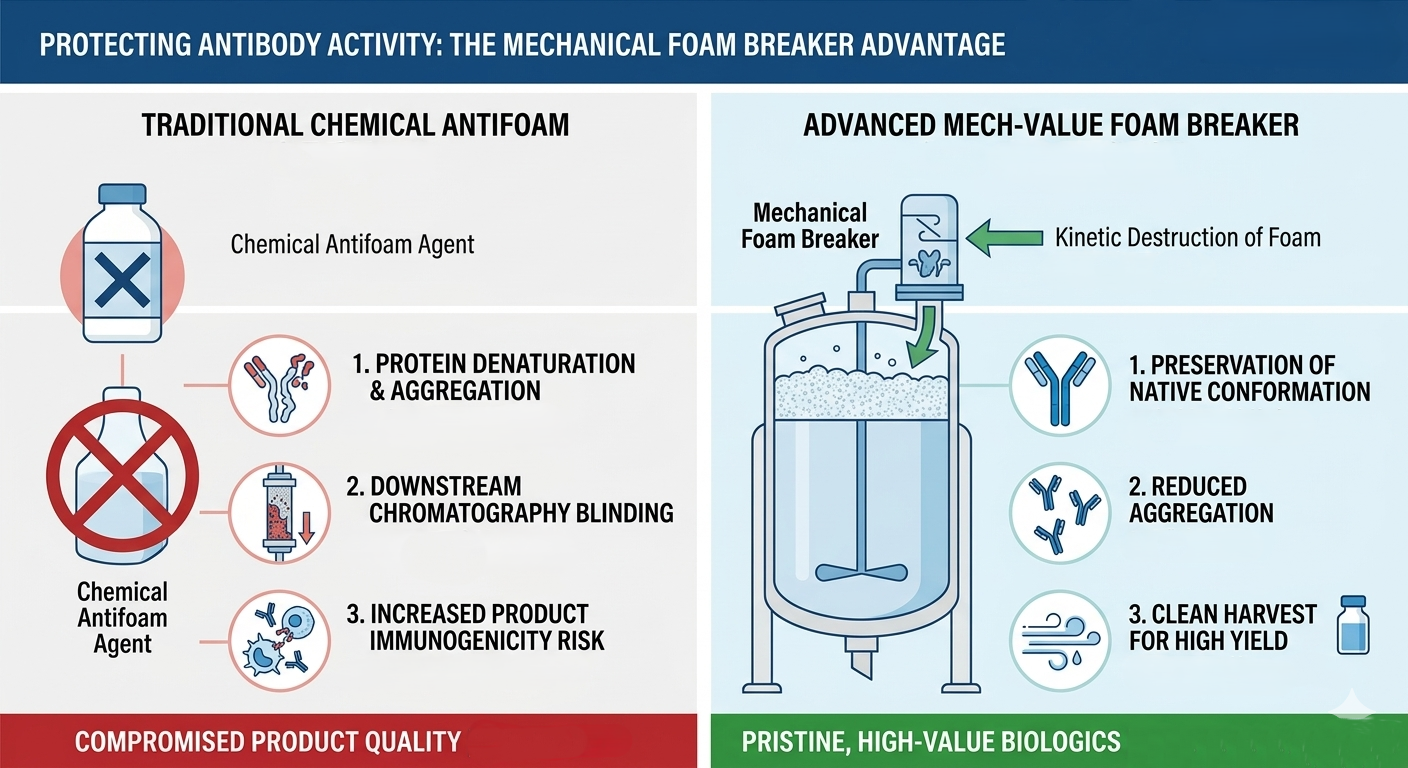
In the biopharmaceutical manufacturing of monoclonal antibodies (mAbs) and therapeutic recombinant proteins, the biological activity and safety profile of the final product dictate its market value and regulatory compliance. Modern high-density Chinese Hamster Ovary (CHO) cell suspension cultures, combined with vigorous aeration and agitation, naturally generate massive amounts of thick, resilient foam inside the bioreactor.
For decades, processing facilities have relied on chemical antifoam agents to suppress this surface foam. However, this traditional chemical intervention introduces an expensive, hidden trade-off—it inflicts silent, structural damage on both the cellular culture environment and the fragile antibody molecules themselves.
Integrating a mechanical defoamer (also engineered as a mechanical foam breaker) provides a physical, chemical-free alternative for mAb production lines. By destroying foam through precision kinetic force, this hardware eliminates external chemical contaminants, directly safeguarding target protein activity and accelerating downstream recovery yields.
Monoclonal antibodies are complex, delicate macromolecules that are highly sensitive to changes in surface tension and shear stress. Relying on silicone-based or synthetic polyether chemical surfactants for process control introduces severe product quality liabilities:
• Inducing Protein Denaturation and Aggregation: Chemical antifoams are powerful surfactants. They interact directly with the hydrophobic cores of mAb molecules, disrupting their advanced tertiary structures. This triggers protein unfolding and causes irreversible protein aggregation inside the vessel, lowering the concentration of active, functional antibodies.
• Elevating Product Immunogenicity Risks: Residual chemical antifoams that carry over into the finished product can trigger adverse immune responses in patients. Consequently, regulatory bodies enforce strict ppm thresholds for antifoam residues in final injectables, forcing manufacturers to perform exhaustive downstream validation testing.
• Blinding Downstream Chromatography Columns: Silicone residues readily adsorb onto expensive chromatography media, blinding affinity resins (such as Protein A) and ion-exchange columns. This surface fouling drops binding capacities, reduces separation resolution, and decreases the overall recovery yield of high-purity mAbs.
A mechanical foam breaker completely eliminates these chemical risks. Mounted directly on the bioreactor or the off-gas line, the equipment utilizes centrifugal force to physically shatter the foam structure, spinning the sterile liquid phase back into the broth while venting the gas cleanly.
This physical mechanism directly upgrades the biochemical and visual profiles of your market-ready single-clone antibodies:
• Preservation of Native Antibody Conformation: With zero chemical additives introduced during cultivation, antibody molecules mature in a clean, pristine medium. Free from foreign surfactant interference, the final mAbs perfectly retain their native three-dimensional conformation and target-binding affinity.
• Significant Reduction in Aggregation Rates: The mechanical foam breaker instantly collapses the foam layer using controlled kinetic energy, preventing foam from stagnating in the headspace. This minimizes the time antibodies spend trapped at the gas-liquid interface, where compression and dehydration normally induce protein clumping.
• Clean Harvest Fluids for High Downstream Yields: The harvested culture broth arriving at the purification stage remains completely pure and surfactant-free. Downstream ultrafiltration membranes and chromatography columns operate at maximum efficiency, resulting in sharper elution peaks and finished product purity that easily meets clinical standards.
Beyond directly protecting the antibody molecule, a mechanical defoaming system stabilizes the broader upstream environment, ensuring consistent batch-to-batch product output:
• Sustaining Premium Cell Viability: Eliminating chemical surfactants removes the chemical osmotic stress placed on CHO cell membranes. Cells maintain high viability profiles throughout the cultivation cycle, which minimizes the release of host cell proteins (HCP) and endotoxins from lysed cells, alleviating the downstream purification burden.
• Unimpeded Mass Transfer (OTR): Without a chemical film coating the liquid surface, oxygen transfer rates (OTR) remain at peak performance. Air bubbles stay small and uniform, providing optimal dissolved oxygen to the culture. This ensures highly active cell metabolism, leading to more complete and consistent glycan post-translational modifications on the final antibody.
In the production of high-value biopharmaceuticals, even a minor process impurity can lead to the rejection of an entire multi-million-dollar batch. A mechanical defoamer eliminates the risk of chemical degradation and chromatography fouling, providing a clear path to generating highly active, residue-free monoclonal antibodies.