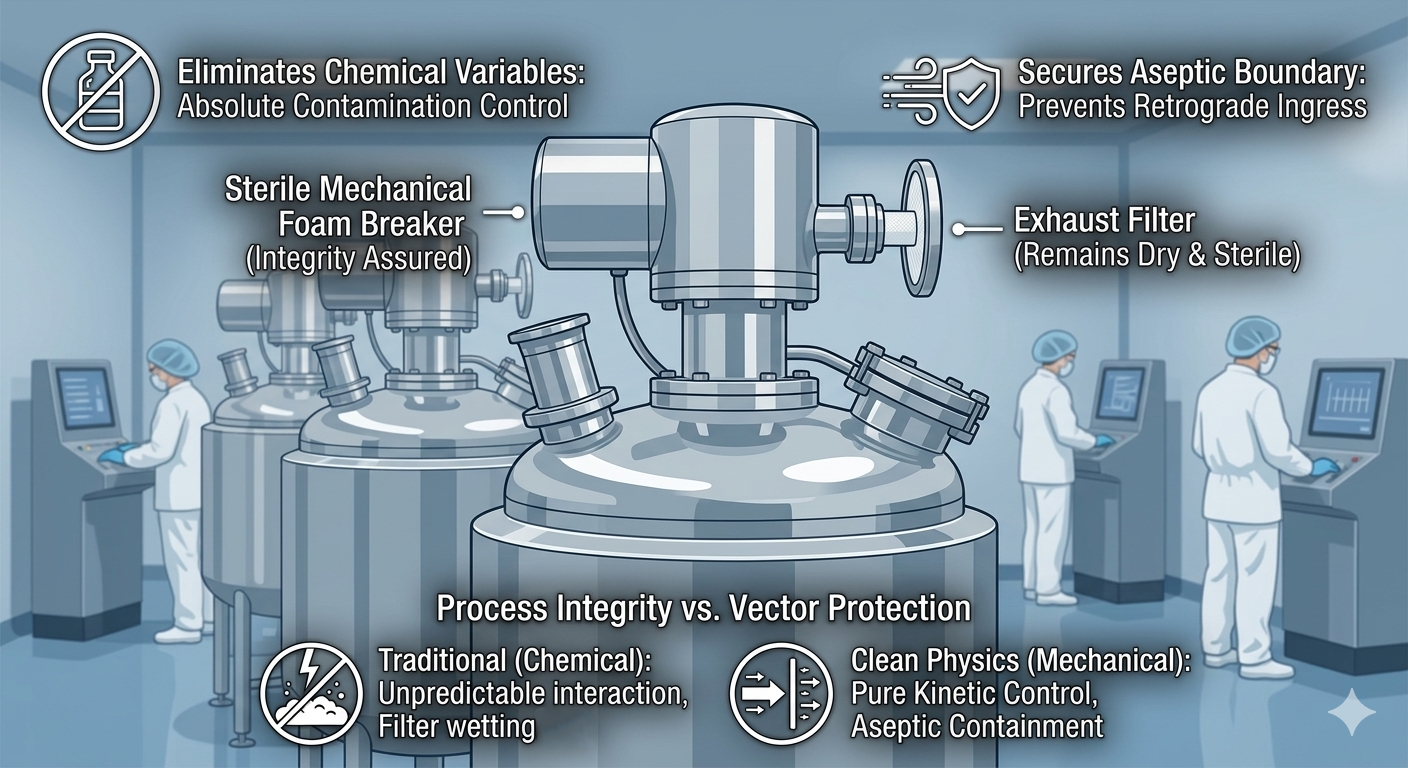
In the demanding world of biopharmaceutical manufacturing, maintaining a sterile environment is non-negotiable. Traditional foam control methods, such as chemical antifoams, introduce unwanted variables that compromise the sterile loop.
Our Stainless Steel Mechanical Defoamers for Sterile Bioreactor Applications offer a clean, engineered alternative that replaces chemical dosing with physical kinetic force. Designed as a seamless extension of your pressure vessel's sterile boundary, this dedicated hardware forms an impenetrable aseptic barrier while effectively suppressing foam. The result is an uncompromised cultivation environment that protects high-value biological batches from contamination risks.
Technical Risks: Contamination Vectors in Traditional Defoaming
Standard industrial defoaming methods often create critical vulnerabilities in high-purity, closed-loop bioreactors. When upgrading your facility, it is vital to eliminate these three specific risk areas:
- Filter Wetting and Ingress: Aggressive foaming can saturate hydrophobic sterile venting filters at the exhaust system. Once a filter membrane becomes wet, it blocks off-gas flow, spikes vessel pressure, and creates a liquid bridge that allows ambient pathogens to migrate backward into the reactor.
- Extractables and Leachables: Chemical antifoams introduce synthetic surfactants into the sterile medium. These molecules alter the chemical matrix and interact unpredictably with sensitive proteins or cellular membranes, complicating raw material traceability and contamination profiling.
- Microbial Harboring Points: Conventional rotating machinery often features exposed threads, sharp internal corners, or unpolished welds. These micro-crevices trap organic residue and shield bacteria from sterilizing agents, leading to recurring batch contamination.
Engineering Architecture of Our Sterile Mechanical Defoamers
Our sterile mechanical foam breakers are fundamentally structured to eliminate these contamination vectors, utilizing advanced aseptic engineering to secure your closed-loop process:
- Hermetic Magnetic Sealing: To prevent atmospheric air exchange along the high-speed rotating shaft, our equipment utilizes advanced magnetic drive couplings or double-cartridge mechanical seals backed by a continuous sterile steam or condensate barrier.
- Electropolished Contact Surfaces: Fabricated exclusively from low-carbon Stainless Steel 316L, all internal components undergo rigorous electropolishing to achieve an ultra-smooth finish. This eliminates microscopic surface pits, preventing biomass adhesion and biofilm accumulation.
- Sanitary Self-Draining Geometry: The internal housing features sloped flow channels and zero dead legs. This open geometry guarantees that clean-in-place (CIP) fluids and high-temperature sterilize-in-place (SIP) steam flow freely through every internal component for verified, repeatable sterilization.
Secure Your Aseptic Boundary Today
Do not let filter failure or chemical residues threaten the security and regulatory compliance of your high-value biological batches. Invest in an engineered, physical containment solution designed specifically to withstand the rigorous demands of strict aseptic processing.
With our stainless steel mechanical defoamer, you ensure that your sterile cultivation environment remains entirely uncompromised from inoculation to harvest.