English
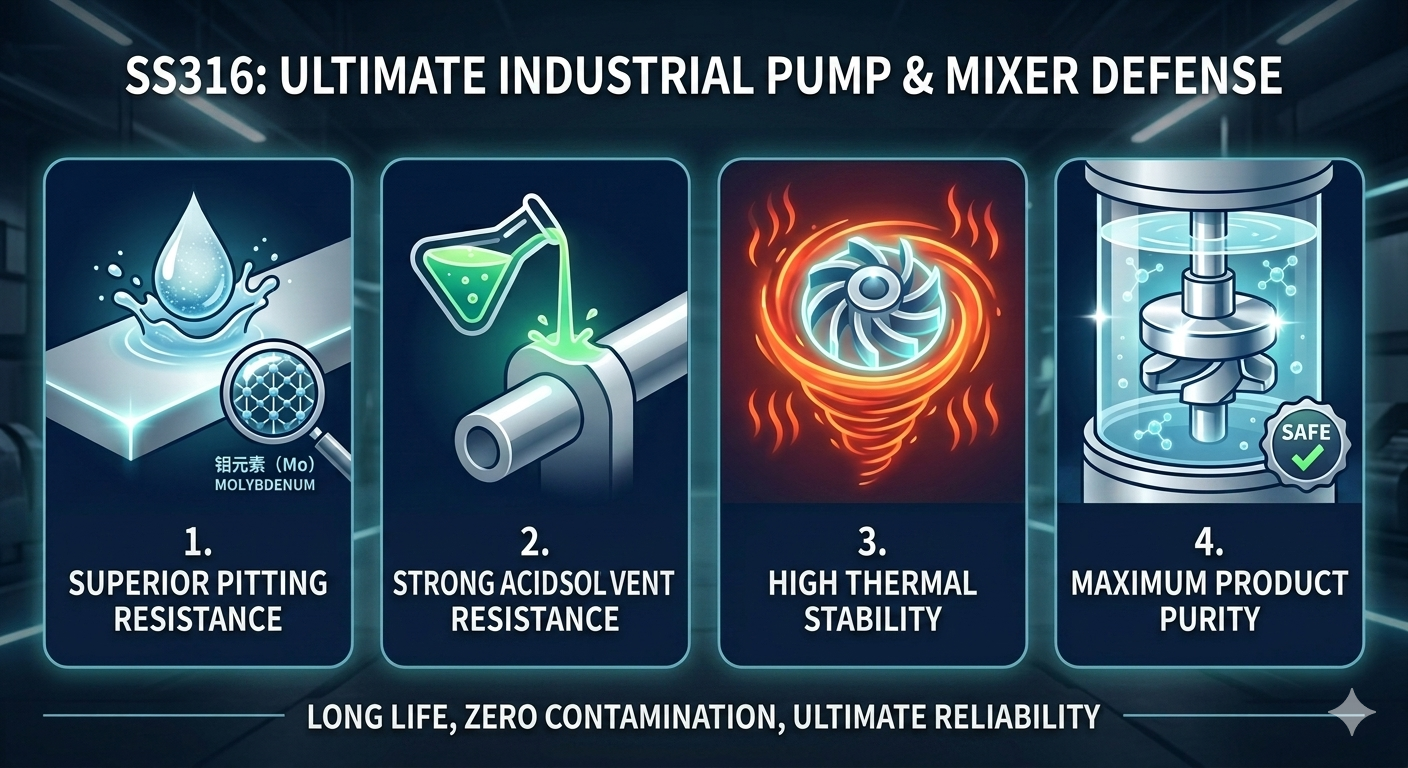
In harsh industrial environments, standard stainless steel often fails prematurely due to localized pitting and chemical erosion. For processing lines that handle corrosive fluids, high-salinity mixtures, or aggressive chemical compounds, upgrading to SS316 (AISI 316 stainless steel) for your industrial pumps and mixing equipment is not just an option—it is non-negotiable. It serves as the ultimate line of defense against catastrophic equipment failure and batch contamination.
The defining feature that sets SS316 apart from SS304 is the addition of 2% to 3% Molybdenum. This single chemical element fundamentally transforms the alloy’s metallurgical structure. It provides exceptional resistance to pitting and crevice corrosion, which are localized forms of rust caused by saltwater, brackish water, industrial brines, and chlorine-heavy liquids. While chlorides can easily break down the passive layer of standard steel, SS316 maintains its surface integrity under continuous exposure to halogen ions. For your SFM Externally Mounted Magnetic Stirrer or High Capacity Sanitary Magnetic Drive Pump, this means sustained performance even in brine processing or CIP return applications.
Industrial mixing equipment and high-pressure pumps frequently process aggressive mediums that destroy lesser metals. SS316 offers superior chemical resistance to higher concentrations of acetic, phosphoric, and mild sulfuric acids, as well as various industrial solvents. Whether you are blending chemical slurries using your SFMA Internally Mounted Magnetic Stirrer or pumping volatile liquids through your High Head Centrifugal Pump, an SS316 pump casing and mixing impeller ensure that the machinery does not degrade, leach metal ions into the product, or cause hazardous leaks. This is critical for your Standard Sanitary Centrifugal Pump and Micro Flow Sanitary Magnetic Drive Pump operating in pharmaceutical blending lines.
Mixing and pumping dense, high-viscosity chemical media can generate immense frictional heat and mechanical stress. Furthermore, industries like pharmaceuticals and biotechnology demand frequent Steam-in-Place (SIP) sterilization at elevated temperatures. SS316 exhibits outstanding creep resistance and thermal stability. It maintains its mechanical strength and corrosion resistance even at high operating temperatures, ensuring your mixing shafts and pump internals do not experience thermal fatigue or deformation. Whether you use a BOZPY Sanitary CIP Return Pump or a High Flow Sanitary Centrifugal Pump, SS316 guarantees reliable sterilization cycles without warping or cracking.
In the pharmaceutical, biotech, and premium food sectors, even microscopic corrosion is unacceptable. If a mixer blade on your WSCJ Externally Mounted Magnetic Stirrer or a pump rotor in your Small Sanitary Centrifugal Pump experiences slight rust, it can ruin an entire batch of high-value medicine or organic formulas, costing thousands of dollars. SS316 is fully compliant with strict global sanitary standards such as FDA and 3-A. Its high resistance to chemical breakdown ensures that your process media remains 100% pure and uncontaminated from start to finish. While SS316 requires a higher upfront investment compared to SS304, its long-term cost benefits are unmatched. It drastically extends the service life of your wet-end components, eliminates unexpected downtime, and prevents costly product contamination. When your processing line involves salt, acids, or high temperatures, choosing SS316 is the only way to guarantee maximum reliability for your pumping and mixing systems.