Selecting the ideal O-ring, gasket, or sealing profile for your magnetic mixing equipment is a foundational step toward achieving complete process containment, prolonged equipment life, and absolute operational safety. As a premier manufacturer specializing in high-performance magnetic stirrers, etc., we understand that sealing components are often subjected to brutal operational conditions. A miscalculated sealing specification can result in gradual pressure decay, batch cross-contamination, unexpected fluid leakage, and costly unplanned industrial downtime.
To support chemical engineers, laboratory administrators, and industrial procurement managers in optimizing their technical selections, this comprehensive engineering guide provides an exhaustive analysis of the four prominent sealing compounds utilized in modern mixing: NBR, EPDM, Viton, and PTFE. We examine their structural molecular behaviors, strict operational temperature limits, specific fluid compatibilities, and targeted dynamic and static sealing applications.
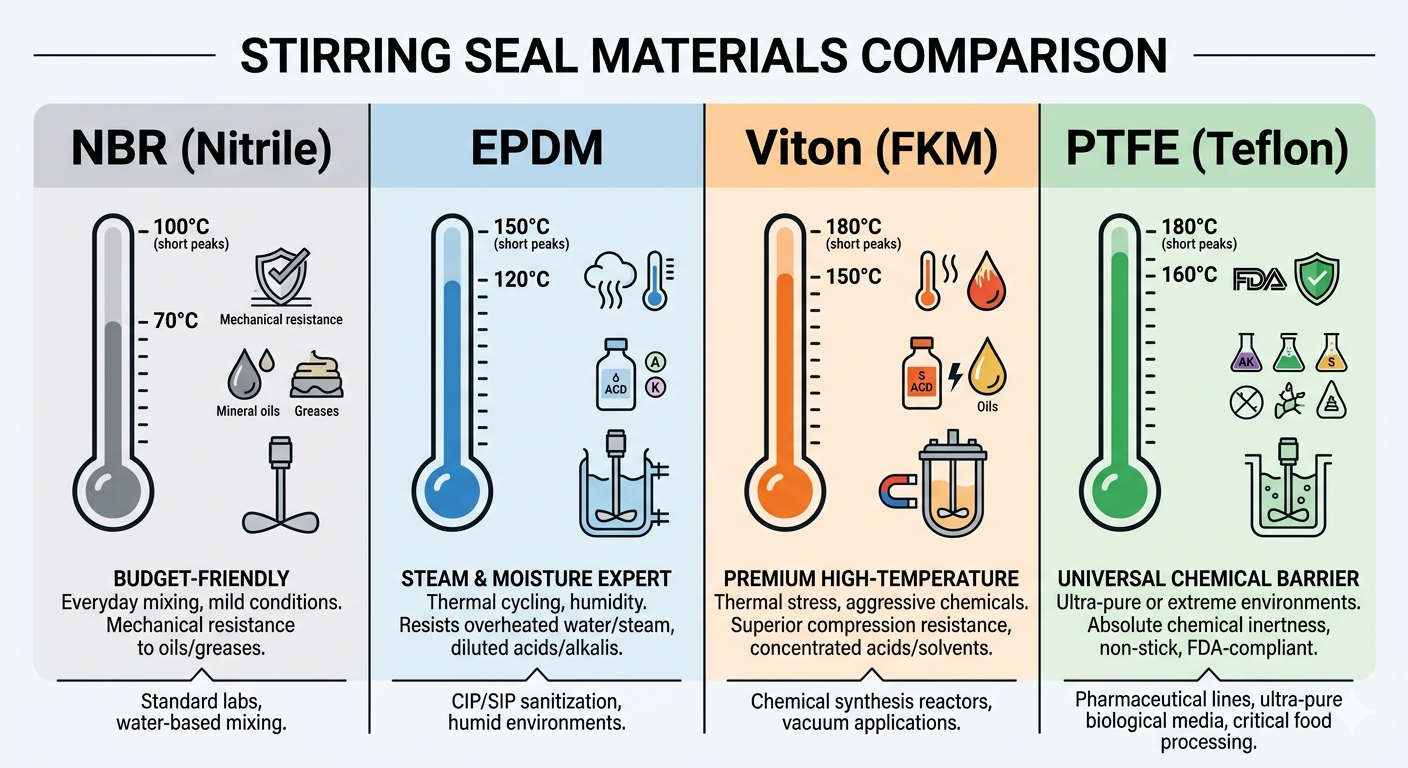
Quick Comparison: Magnetic Stirrer Seal Materials
| Seal Material | Continuous Temp | Max Peak Temp | Primary Strengths | Best Application Media |
|---|
| NBR | < 70°C | 100°C | Cost-effective, High oil resistance | Water, Mild buffers, Mineral oils, Greases |
| EPDM | < 120°C | 150°C | Steam resistance, CIP/SIP stable | Jacketed hot water, Steam, Diluted acids |
| Viton (FKM) | < 150°C | 180°C | High-heat stability, High vacuum | Concentrated acids, Hydrocarbons, Hot oil |
| PTFE (Teflon) | < 180°C | 180°C | Absolute inertness, FDA purity | Ultra-pure pharma, Strong alkalis, Solvents |
1. NBR (Nitrile Butadiene Rubber) — The Mechanical and Budget-Friendly Standard
Nitrile Butadiene Rubber, universally designated as NBR, represents a specialized copolymer synthesized from acrylonitrile and butadiene. It serves as the workhorse industrial standard for systems demanding robust volumetric cost control without compromising foundational mechanical integrity under non-corrosive parameters.
- Operational Limits and Thermal Boundaries: For worry-free and prolonged continuous runs within a magnetic stirrer assembly, operations must be strictly maintained below 70°C. NBR is capable of managing short-term, instant thermal spikes up to 100°C, but continuous operation beyond 70°C rapidly accelerates polymer cross-linking, causing irreversible seal embrittlement, structural hardening, and premature micro-cracking.
- Material Properties and Sealing Advantages: The primary engineering merit of NBR lies in its outstanding volumetric stability and swell resistance when exposed to non-polar fluids. Its unique molecular structure provides excellent resistance to abrasion, mechanical tearing, and persistent compression set under load. NBR maintains exceptional sealing pressure over thousands of operational cycles under moderate compression.
- Targeted Stirring Media and Application Scenarios: NBR seals are ideal for general laboratory blending tasks, basic water-based liquid preparations, and mild aqueous buffer formulations. Furthermore, it is the premier cost-conscious choice when testing mineral oils, industrial greases, hydraulic lubricants, or petroleum products on standard heating-plate magnetic stirrers.
2. EPDM (Ethylene Propylene Diene Monomer) — The Moisture and Sanitization Expert
Ethylene Propylene Diene Monomer, or EPDM, is a specialized synthetic elastomer characterized by an entirely saturated polymer backbone. This specific molecular arrangement provides EPDM with exceptional natural defense against structural weathering, environmental stress cracking, and severe moisture degradation.
- Operational Limits and Thermal Boundaries: For continuous hot runs, peroxide-cured EPDM reliably supports operating temperatures below 120°C. It easily withstands short-term sterilization peaks or system thermal spikes up to 150°C. Exceeding the 120°C continuous limit in dry or inappropriate environments may cause a gradual reduction in elasticity and subsequent sealing force loss.
- Material Properties and Sealing Advantages: EPDM is globally celebrated for its exceptional flexibility, profound crack-propagation resistance, and outstanding stability against ozone and polar chemicals. It exhibits virtually zero swelling when exposed to heated fluids, allowing it to maintain a fluid-tight static lock on tank mounting flanges. It provides a long-lasting mechanical barrier under variable thermal cycling conditions.
- Targeted Stirring Media and Application Scenarios: EPDM seals are highly recommended for jacketed hot-water circuits, low-pressure steam injection lines, and high-humidity mixing lines. EPDM is structurally suited for handling diluted industrial acids, environmental buffers, and alkaline fluids. It is widely specified in hygienic industries where mixing hardware must endure intensive Clean-in-Place (CIP) or Steam-in-Place (SIP) chemical washdowns.
3. Viton (FKM) — The Premium High-Heat and Vacuum Standard
Viton, a high-performance fluorinated hydrocarbon elastomer globally categorized as FKM, incorporates a heavily fluorinated molecular architecture. This profound carbon-fluorine bond concentration gives Viton superior resistance to both high-temperature thermal degradation and molecular chemical degradation.
- Operational Limits and Thermal Boundaries: Viton is engineered for demanding industrial processes, easily maintaining structural integrity at continuous temperatures below 150°C. It is fully capable of withstanding critical short-term thermal peaks or intense localized spikes up to 180°C. Care must be taken not to utilize Viton beyond its chemical limits, as thermal breakdown at extreme temperatures can release hazardous fluoric compounds.
- Material Properties and Sealing Advantages: The structural hallmark of Viton is its superior resistance to continuous compression set at elevated temperatures, ensuring that the seal does not flatten or relax over extended production campaigns. It possesses low outgassing characteristics, high density, and superior flame retardation, making it excellent for maintaining seal integrity in high-vacuum configurations.
- Targeted Stirring Media and Application Scenarios: Viton is the premium sealing choice for complex chemical synthesis reactors, vacuum-jacketed distillation vessels, and sophisticated top-mounted magnetic coupling assemblies. It provides total containment when blending concentrated acids, aggressive hydrocarbons, chlorinated solvents, synthetic lubricants, and high-temperature organic chemicals.
4. PTFE (Teflon) — The Universal Chemical Purity Barrier
Polytetrafluoroethylene, widely referred to as PTFE or Teflon, is a high-molecular-weight fluoropolymer. Unlike elastomers, it consists entirely of carbon and fluorine atoms, giving it a universally non-reactive exterior shell that makes it virtually immune to chemical decomposition.
- Operational Limits and Thermal Boundaries: While pure PTFE possesses a high melting point, its mechanical load-bearing capacity requires continuous operations to remain below 160°C. It can manage short-term sterilization cycles up to 180°C. Operating above 160°C under heavy structural load can cause material deformation due to creep, which may create micro-gaps if the flange assembly is poorly retained.
- Material Properties and Sealing Advantages: PTFE offers universal chemical inertness, a near-zero coefficient of friction, and a completely non-stick surface that eliminates fluid absorption. To overcome pure PTFE’s natural lack of rubber-like elasticity and its tendency to undergo "cold flow" (slow deformation under continuous load), we offer hybrid PTFE-encapsulated O-rings. These feature a resilient silicone or Viton core wrapped inside a seamless, fluid-tight PTFE jacket, providing the complete chemical protection of Teflon alongside permanent elastic sealing force.
- Targeted Stirring Media and Application Scenarios: PTFE seals are essential for ultra-pure biopharmaceutical processing lines, high-purity food blending plants, strong alkalis, and aggressive organic chemical synthesis. It guarantees absolute, zero-leach, and FDA-compliant purity for your products.