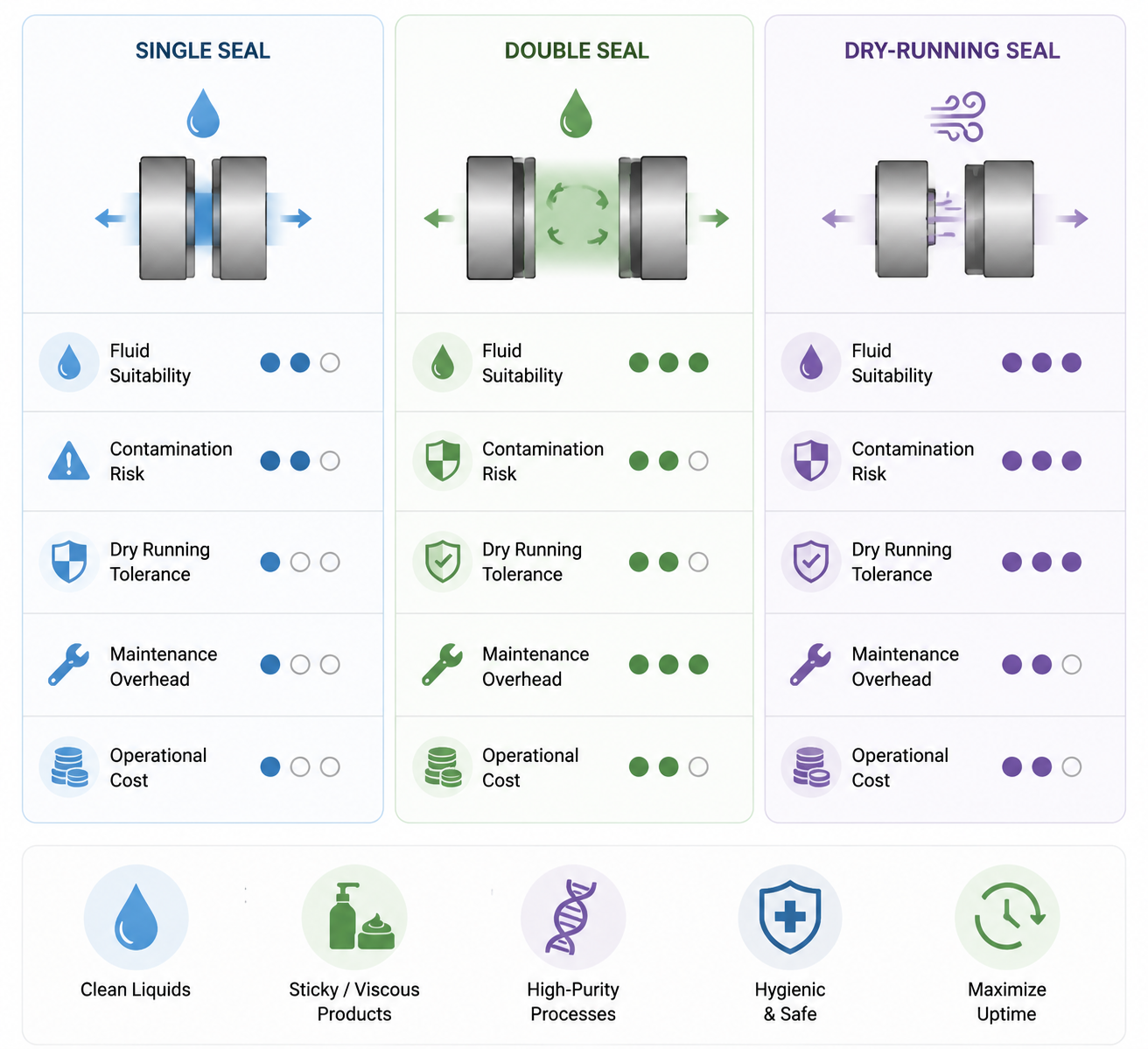
Selecting the right mechanical seal architecture for sanitary centrifugal pumps directly impacts process security, batch integrity, and the total cost of ownership (TCO). In high-purity industries—such as oral liquid production, biopharmaceutical formulations, micellar water manufacturing, food processing, and chemical fluid transfer—mechanical seals act as critical process control variables. Choosing between single, double, or dry-running mechanical seals requires a strict engineering analysis of fluid dynamics, crystallization tendencies, and operational failure modes.
Technical Architectures and Sealing Mechanics
The fluid-mechanical boundaries of these three sealing methodologies dictate their performance under demanding hygienic conditions:
- Single Mechanical Seals utilize a single set of mating faces lubricated and cooled entirely by a microscopic film of the process fluid itself. Frictional heat dissipates into the atmosphere, offering a mechanically simple and cost-effective design for stable fluid transfer.
- Double Mechanical Seals employ two independent pairs of sealing faces enclosing an intermediate chamber filled with a pressurized buffer or barrier fluid circuit. This external fluid loop constantly cools the faces and acts as a secondary containment layer.
- Dry-Running Mechanical Seals operate completely without liquid lubrication. They leverage specialized self-lubricating materials or laser-etched aerodynamic micro-grooves that compress gas into a high-pressure cushion, separating the seal faces during shaft rotation.
Fluid Suitability and Contamination Risk Matrices
Mismatched seal selection leads to immediate face destruction, micro-leakage, and expensive product loss across different hygienic applications:
- Clean and Low-Viscosity Fluids: In oral liquid production or standard food processing handling simple syrups and purified water, single mechanical seals are highly efficient. They transfer clean, non-crystallizing liquids with minimal maintenance.
- Surfactants and Crystallizing Mediums: For micellar water manufacturing or fluids with high sugar concentrations, single seals fail prematurely. Atmospheric exposure causes fluid evaporation and immediate crystallization at the micro-gap edge, grinding the polished seal faces. Double mechanical seals resolve this by submerging the faces in a continuous liquid loop, making them mandatory for sticky lotions, heavy creams, and viscous bioprocess fluids.
- Absolute Purity and Dilution Risks: While double seals under a pressurized barrier setup provide excellent containment against microbial ingress, they introduce an inward leakage risk during sudden system pressure drops. For premium facial serums or high-purity biological processes, this batch dilution is unacceptable.
- Biofilm Prevention: Dry-running seals eliminate inward liquid leakage by removing all barrier fluids, utilizing sterile air or inert nitrogen to maintain the non-contact gas cushion. This dry configuration removes fluid-trapping pockets, preventing bacteria from anchoring and building microbial biofilms during clean-in-place (CIP) cycles.
Operational Longevity and Maintenance Overhead
The ancillary infrastructure required by each mechanical seal variant defines the long-term operational efficiency of the processing line:
- Single Seals minimize initial capital expenditure and hardware complexity. However, they lack dry-run tolerance. Any unexpected tank starvation causes instantaneous thermal shock, cracking the silicon carbide or carbon faces within seconds.
- Double Seals require complex external support systems—including fluid reservoirs, barrier pumps, and pressure regulators—to maintain the flush plan loop. While this setup increases maintenance overhead, it provides an engineering fail-safe that cools the faces if the pump runs dry during continuous chemical or food production.
- Dry-Running Seals neutralize component damage from operator error or accidental dry running by maintaining extended dry endurance. Eliminating the liquid barrier infrastructure reduces annual pump maintenance overhead by up to 30%, streamlines automated CIP validation, and maximizes system uptime in high-head and high-flow centrifugal pump applications.