
English
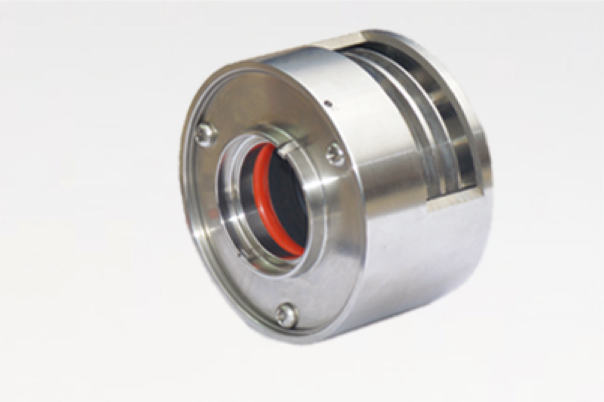
In sanitary fluid transfer, conventional mechanical seals rely on liquid films to lubricate and cool their rotating faces. However, external liquid flushing infrastructure poses contamination risks to formulations and increases operational complexity. For ultra-pure cosmetics, biotechnology, and pharmaceutical batches, dry-running mechanical seals offer an engineered alternative. Operating without external liquid lubrication, these components rely on structural metallurgy and micro-topographical aerodynamics to eliminate microbial growth zones and safeguard product purity.
The Core Physics: Eliminating the Liquid Crutch
In a conventional seal, the liquid film between the stationary and rotating faces serves two purposes: it lubricates to reduce friction and it carries away heat. Without that film, traditional seal faces crack under immediate thermal shock. A dry-running seal, conversely, operates without any external liquid lubrication. It relies on two pillars: advanced material metallurgy and micro-topographical aerodynamics.
1. Advanced Material Formulation and Solid Tribology
The structural core of a dry-running seal is a precision pair of materials—typically a silicon carbide and carbon composite pairing, or specialized ceramic alloys. These materials are selected for extreme surface hardness and a naturally low coefficient of friction during solid contact. When the pump shaft rotates, the sliding interface generates minimal heat because the material pair is self-lubricating at the molecular level. This allows the faces to run dry for extended periods without thermal cracking or catastrophic failure. For your hygienic centrifugal pumps in the chemical industry, where accidental dry-run events due to operator error can cost tens of thousands in lost production, this dry-run endurance is a game-changer.
2. Aerodynamic Lift and Micro-Gap Gas Mechanics
Here is where the physics gets elegant. Modern dry-running seals employ hydrodynamic or aerodynamic lift principles. The seal face is precision-machined with microscopic spiral grooves or wave profiles—barely visible to the naked eye. As the pump rotor spins, these micro-grooves act as miniature compressor blades. They draw the surrounding ambient air (or product micro-vapors) into the interface, compressing the gas toward the center of the seal face. This localized pressure accumulation creates an aerodynamic opening force. When this force balances the mechanical spring tension holding the faces together, the seal faces separate by a microscopic cushion of gas—less than one micrometer thick. The tribological regime shifts from solid-to-solid friction to non-contact gas lubrication. Your pump now operates with zero mechanical wear on the seal faces, and zero liquid ingress into the product stream.
The Sanitary Advantages: Pure Fluid Path Isolation
For your applications—whether it is ensuring contamination-free transfer in micellar water manufacturing or maintaining sterility in biopharmaceutical production—the benefits are profound. First, there is zero batch dilution. Traditional seals can leak barrier buffer fluids into the formulation line during pressure drops. Dry-running seals eliminate this contamination vector completely. Second, the housing is self-cleaning. Without fluid trapping chambers or external barrier piping, the surrounding seal area has no dead spaces for bacteria to colonize. This dramatically improves the efficiency of your automated CIP cycles. Third, the dry-running environment prevents biofilm formation. Bacteria need stagnant moisture pockets to anchor and form protective biofilms. Your seal housing remains dry, denying them that habitat.
Technical Operational Boundaries: What You Need to Know
These are not universal solutions. Dry-running mechanical seals are optimized for low-to-medium pressure applications and standard rotational velocities. If your process experiences severe pressure spikes exceeding the aerodynamic lift profile’s design parameters, the gas cushion collapses. The faces then slam into high-load mechanical contact, which can cause scoring and seal failure. Therefore, I always recommend pairing these seals with robust pump protection systems, such as pressure relief valves or variable frequency drives, to keep operating conditions within the engineered envelope.
Why This Matters to Your Bottom Line
When you specify a dry-running mechanical seal in your next hygienic centrifugal pump for the food and beverage industry, or for your oral liquid production line, you are not just buying a component. You are investing in maximized operational efficiency—no external flush systems to install, no barrier fluid to monitor, no dilution losses. You are investing in lower total cost of ownership—extended seal life, fewer unplanned shutdowns, and faster CIP cycles. And most importantly, you are guaranteeing your end product’s purity, batch after batch.