English
When you are sourcing pumps, mixers, or agitators for your production line, the material choice is far from trivial—it determines your equipment's lifespan, maintenance costs, and overall process integrity. SS304 (AISI 304 stainless steel) has earned its reputation as the workhorse of the sanitary and mild industrial sectors, and here is why it deserves a place on your procurement list.
Exceptional Corrosion Resistance for Standard Fluids
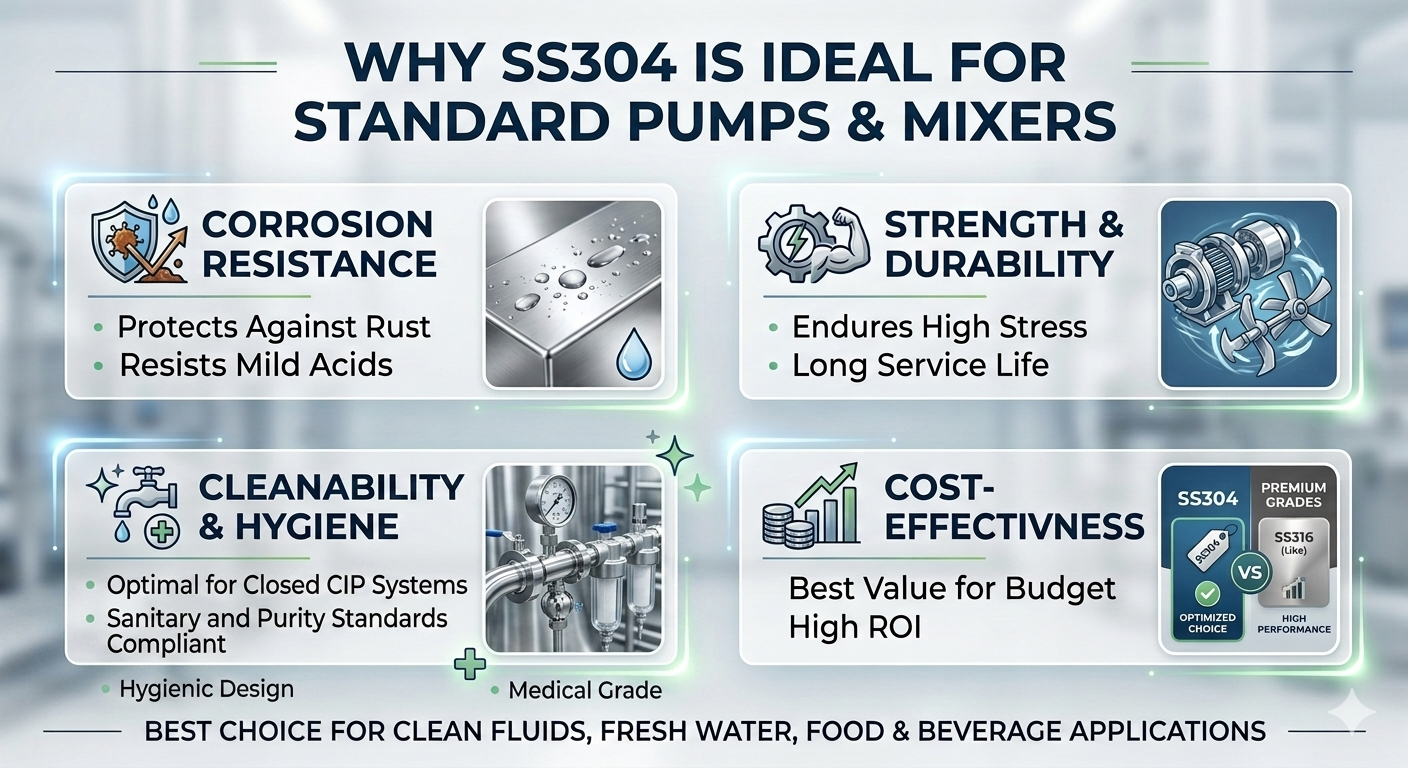
SS304 is an austenitic stainless steel with 18% chromium and 8% nickel. This composition forms a self-healing chromium oxide layer that shields the metal from atmospheric oxidation and mild acids. For applications involving fresh water, dairy, soft drinks, beer, or organic slurries, this means zero rust formation and no metallic contamination. Your fluid purity remains intact from the first batch to the last.
Robust Mechanical Performance Under Load
Inside a centrifugal pump, lobe rotor, or high-shear mixer, components like impellers, shafts, and housings endure constant torque, vibration, and pressure. SS304 delivers strong tensile and yield strength, resisting deformation even in continuous heavy-duty operation. This durability ensures that critical clearances—such as the gap between a rotor and stator in an emulsifier—stay precise, maintaining peak hydraulic efficiency for years.
Superior Sanitary Finish and Cleanability
In food, beverage, and personal care production, bacterial harborage is a non-negotiable risk. SS304 can be mechanically polished or electropolished to a mirror-like finish, eliminating microscopic crevices where biofilms might grow. Moreover, this grade withstands standard Clean-in-Place (CIP) chemicals and hot water cycles without surface degradation, making it fully compliant with 3-A, EHEDG, and FDA sanitary guidelines.
Cost-Effective Value Without Compromise
Here is the pragmatic reality: premium alloys like SS316, with added molybdenum, are often over-specified for about 70% of standard applications. If your fluid lacks high chloride concentrations or aggressive acids, SS304 matches SS316's performance on corrosion resistance, strength, and cleanability—at a significantly lower cost per unit. Choosing SS304 lets you allocate your budget toward other critical areas, such as automation or spares, while still getting a machine built for longevity.
Ultimately, for a vast array of standard mixing and pumping tasks—from bottom-entry magnetic stirrers in fermentation vessels to sanitary centrifugal pumps in CIP loops—SS304 is not just a material option; it is the smarter financial and technical decision. It protects your product, your process uptime, and your bottom line.