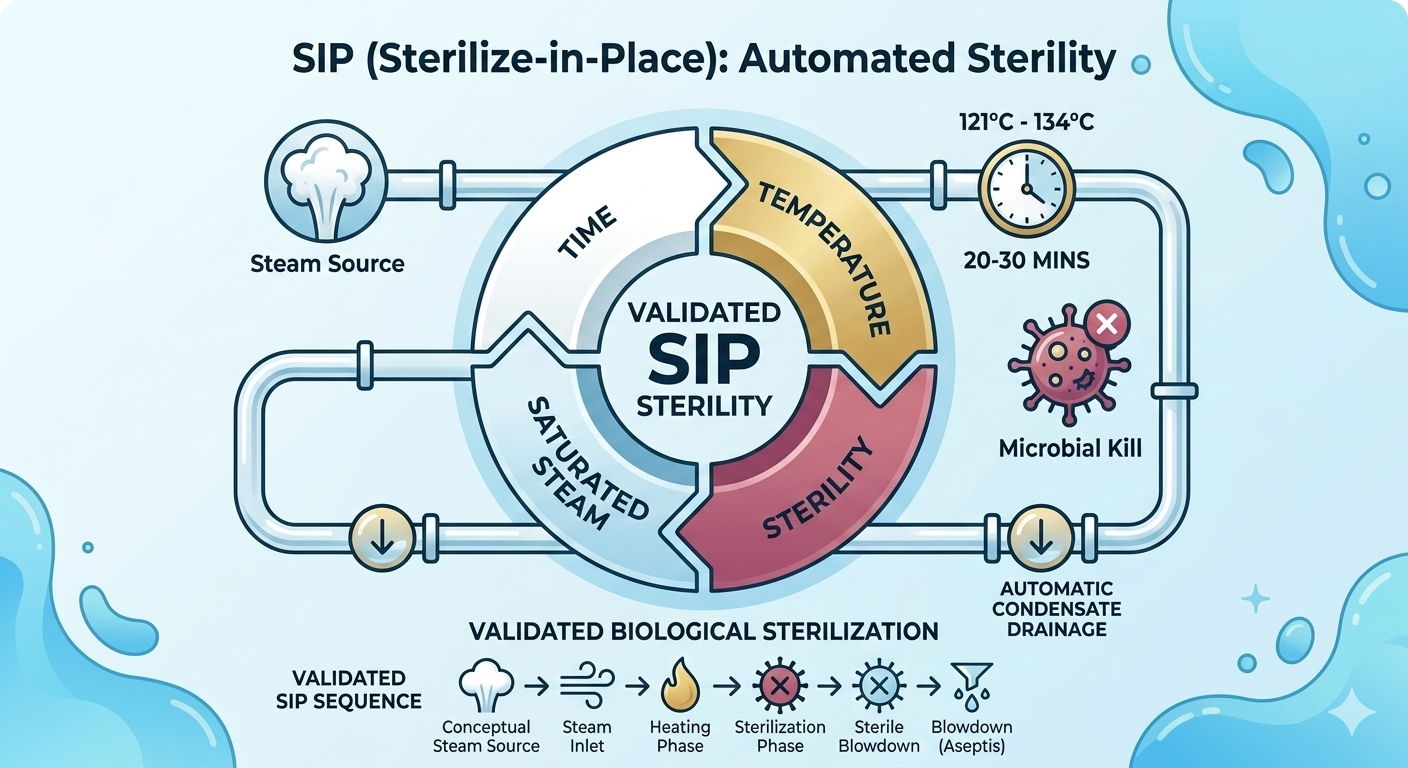
In industries such as biopharmaceuticals, vaccines, dairy, and sterile food processing, achieving a clean system is only the first step. While Clean-in-Place (CIP) successfully removes physical residues, achieving biological sterility requires Sterilize-in-Place (SIP) technology. SIP is an automated validation protocol designed to eliminate all viable microorganisms and bacterial spores within closed fluid processing systems—including process vessels, magnetic agitators, high-shear emulsifying pumps, and sanitary twin-screw pumps—without dismantling any components.
The Physics of SIP: Why Saturated Steam Rules
The industry standard for SIP relies on saturated steam under pressure as the sterilizing agent. Unlike dry heat, saturated steam rapidly transfers thermal energy upon contact with colder metal surfaces, causing the irreversible coagulation and denaturation of microbial proteins.
To achieve validated sterility (typically a Sterility Assurance Level of 10⁻⁶), a successful SIP system must precisely control three interconnected operational variables:
- Sterilization Temperature: The system internal temperature must reach a minimum of 121°C (250°F) to 134°C (273°F).
- Exposure Time: This peak thermal state must be held continuously for 20 to 30 minutes, depending on the validation protocol.
- Continuous Condensate Drainage: As steam loses heat to the equipment, it turns back into water. If this condensate pools, it creates a "cold spot" where sterilization fails. Therefore, fluid systems must be designed with automatic steam traps at all low points.
Engineering SIP-Reliable Mixers and Pumps
- Standard industrial fluid machinery will quickly fail under the extreme thermal expansion and pressure stresses (often up to 3 bar) of continuous SIP cycles. As a dedicated fluid equipment manufacturer, we engineer our processing components to survive and thrive under these harsh conditions:
- Sanitary Magnetic Agitators: Our mag-drive mixers completely eliminate the need for traditional mechanical seals. By utilizing an isolated containment shell and magnetic coupling, they eliminate the risk of shaft leakage and allow high-pressure steam to fully surround and sterilize the internal impeller bearings with zero cross-contamination risks.
- Sanitary Twin-Screw Pumps: Engineered with high-grade SS316L and advanced internal timing gears, our twin-screw pumps excel at handling high-viscosity sterile products. Crucially, they double as a CIP/SIP return pump, maintaining high volumetric efficiency under extreme thermal expansion and ensuring total drainage of condensate during the steam cycle.
- High-Shear Emulsifying Pumps: Our inline high-shear emulsifying pumps feature zero-dead-space paths, allowing steam to fully penetrate every internal rotor-stator gap and seal face during the sterilization phase.
Secure Contamination-Free Production
Investing in SIP-ready processing lines is the ultimate defense against catastrophic batch failures, product recalls, and regulatory non-compliance during cGMP or FDA audits.
Are you upgrading to a sterile production line or looking for high-performance hygienic machinery? Explore our comprehensive catalog of SIP-Compliant Twin-Screw Pumps, Magnetic Agitators, and Inline Emulsifying Pumps, or contact our engineering experts today for a tailored technical consultation.