
English
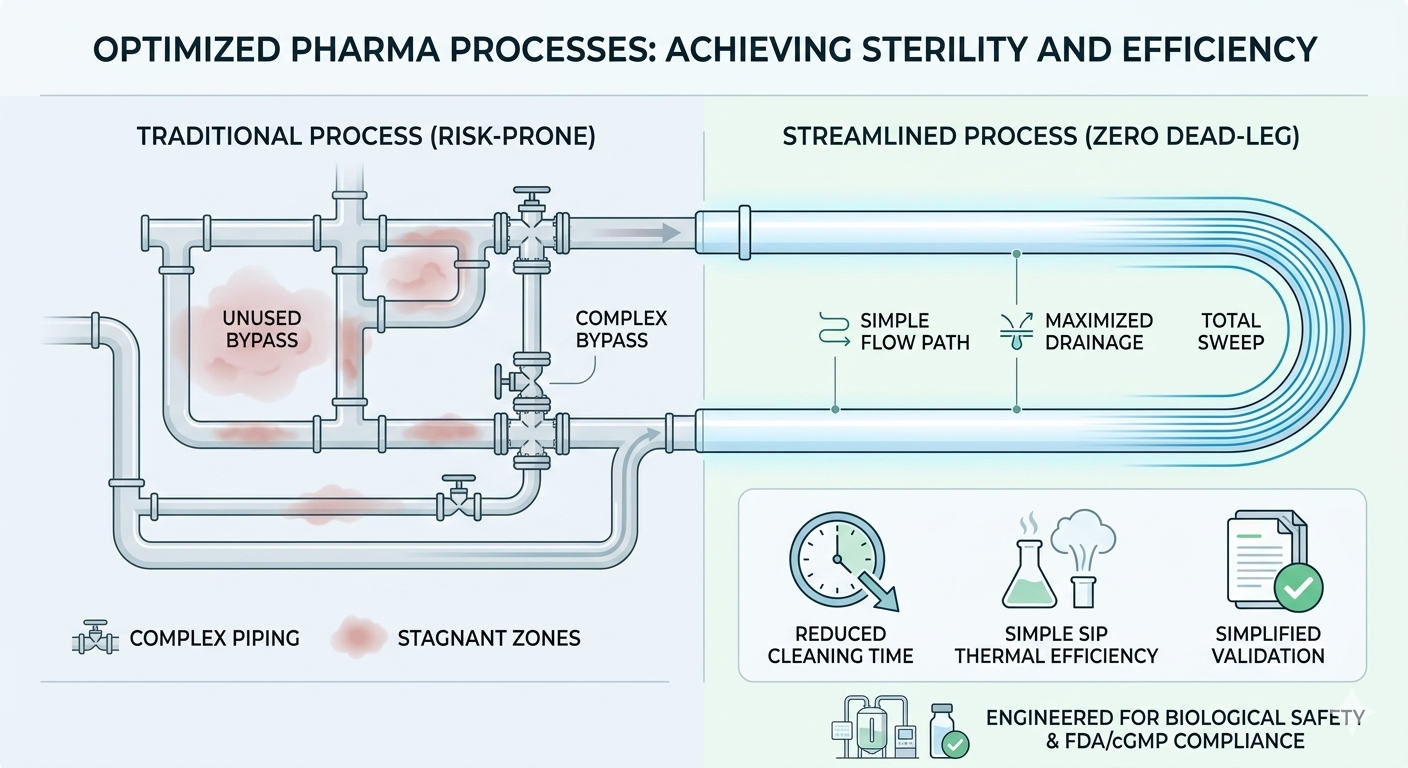
As a seasoned manufacturer of sanitary twin-screw pumps, I've spent decades on the front lines of pharmaceutical engineering, and I can tell you firsthand: the biggest headache in CIP/SIP optimization isn't the cleaning chemistry—it's the mechanical design of your pump. Every dead-leg in your system is a ticking time bomb for contamination, a validation nightmare, and a drain on your bottom line. Let me walk you through how our pump eliminates this risk entirely.
The Equipment Challenge: Dead-Legs and Bioreactor Vulnerability
Pharmaceutical processing lines must conform to stringent ASME BPE standards, which mandate the minimization of dead-legs in fluid pathways. Standard pumps—like traditional lobe or progressing cavity units—present two major mechanical vulnerabilities during sanitation. First, stagnant zones and biofilm formation: internal crevices, deep mechanical seal chambers, and non-draining casing geometries create physical dead-legs. During product transfer or rinsing, fluids bypass these pockets, allowing active pharmaceutical ingredients (APIs) or microbial biofilms to remain trapped, compromising subsequent batches. Second, dual-pump piping complexity: standard low-shear displacement pumps lack the rotational velocity required to generate high turbulent velocities (minimum 1.5 m/s) for effective CIP rinsing. Consequently, plants must install separate, high-flow centrifugal CIP pumps, along with complex bypass piping, automated valves, and headers—multiplying the number of potential dead-leg connections.
The Equipment Solution: Engineering Features for Zero Dead-Leg CIP/SIP
Sanitary twin-screw pumps are engineered from the ground up to serve a dual role: handling highly viscous pharmaceutical products at low speeds, and acting as their own high-flow CIP/SIP supply pump at high speeds, effectively eliminating the mechanical root causes of stagnation. Our 100% self-draining casing geometry features internal contours geometrically optimized for vertical or angled port orientation. This design uses gravity to ensure all liquid drains completely from the pump chamber on shutdown, leaving no stagnant fluid behind before the next process stage or sterilization cycle begins. The frictionless, open profile screws with counter-rotating, intermeshing design have an open, non-contacting profile with precisely machined clearances. During CIP cycles, cleaning fluids flow freely through the entire pumping chamber—including screw flanks and internal core—creating a continuous sweeping action that scrubs all internal surfaces without requiring pump disassembly. Our hygienically designed mechanical seals are flush-mounted in the pump housing, sitting directly in the path of the main fluid flow, eliminating the deep, isolated seal pockets found in traditional pumps and ensuring cleaning and sanitizing agents directly wash the seal faces during every cycle. And our high-RPM turbulent velocity generation, thanks to timing gears and metal-to-metal-free operation, allows safe increases in rotational speed up to 3,000 RPM or more—so the same pump generates the turbulent flow rates required to clean not only itself but also the entire downstream pharmaceutical piping network.
Operational Benefits and System Efficiency
Elimination of bypass piping is a game-changer: by utilizing a single twin-screw pump for both product transfer and CIP return, process engineers can eliminate auxiliary centrifugal pumps, check valves, and bypass lines, directly reducing physical dead-legs in the overall system by up to 50%. Streamlined SIP thermal efficiency comes from our high-purity construction—typically 316L stainless steel with surface roughness of Ra < 0.4 µm, electropolished—and isolated bearing housing, allowing the pump to withstand continuous exposure to saturated steam at temperatures up to 130°C–140°C without thermal distortion or seal degradation. Reduced validation time is another major win: achieving a verified zero dead-leg setup simplifies cleaning validation protocols for FDA/cGMP audits. The absolute drainability and complete fluid sweeping ensure predictable, repeatable cleaning results every time, saving you weeks of validation work and thousands of dollars in documentation.
Summary: Mechanical Integrity for Sterile Compliance
Upgrading to a sanitary twin-screw pump allows pharmaceutical manufacturers to replace complex, risk-prone piping layouts with a streamlined, zero dead-leg fluid transfer system. By pairing 100% drainable internal metallurgy with dual-duty flow capabilities, this robust equipment choice ensures complete biological safety, minimizes chemical waste during rinsing, and maximizes manufacturing plant uptime. If you're tired of wrestling with dead-legs in your CIP/SIP cycles, it's time to make the switch—your sterile compliance depends on it.