
English
When designing a production line or replacing an old unit, one of the most critical decisions is choosing the right pump port connections. The inlet and outlet sizes of your pump directly affect your flow rate, system pressure, and the overall lifespan of your equipment. If your ports are too small, your pump will starve. If the connection type is wrong, you risk leaks, fluid contamination, or costly downtime. As a dedicated manufacturer of industrial and hygienic pumping solutions, we created this port selection guide to help you understand how inlet and outlet sizes work across internal gear pumps, sanitary twin-screw pumps, and lobe rotor pumps.
1. The Golden Rule of Pump Inlet and Outlet Sizes
Before looking at specific pump types, there is a universal rule that every engineer must follow: The suction pipe must never be smaller than the pump's inlet port. The science behind it is simple: pumps do not push liquid into themselves; atmospheric pressure or gravity pushes the liquid in. If the inlet pipe or port is too narrow, the fluid cannot enter fast enough, creating a vacuum that leads to cavitation—air bubbles that collapse violently, causing loud metallic hammering noises, heavy vibrations, and rapid failure of your gears, screws, or rotors. Why is the inlet often larger than the outlet? Many pumps have a larger inlet port and a smaller outlet port to ensure they can easily pull thick fluids in (low suction loss) while building up high pressure on the discharge side to push the liquid down the line.
2. Port Selection for Internal Gear Pumps (Inline & Barrel-Drum Types)
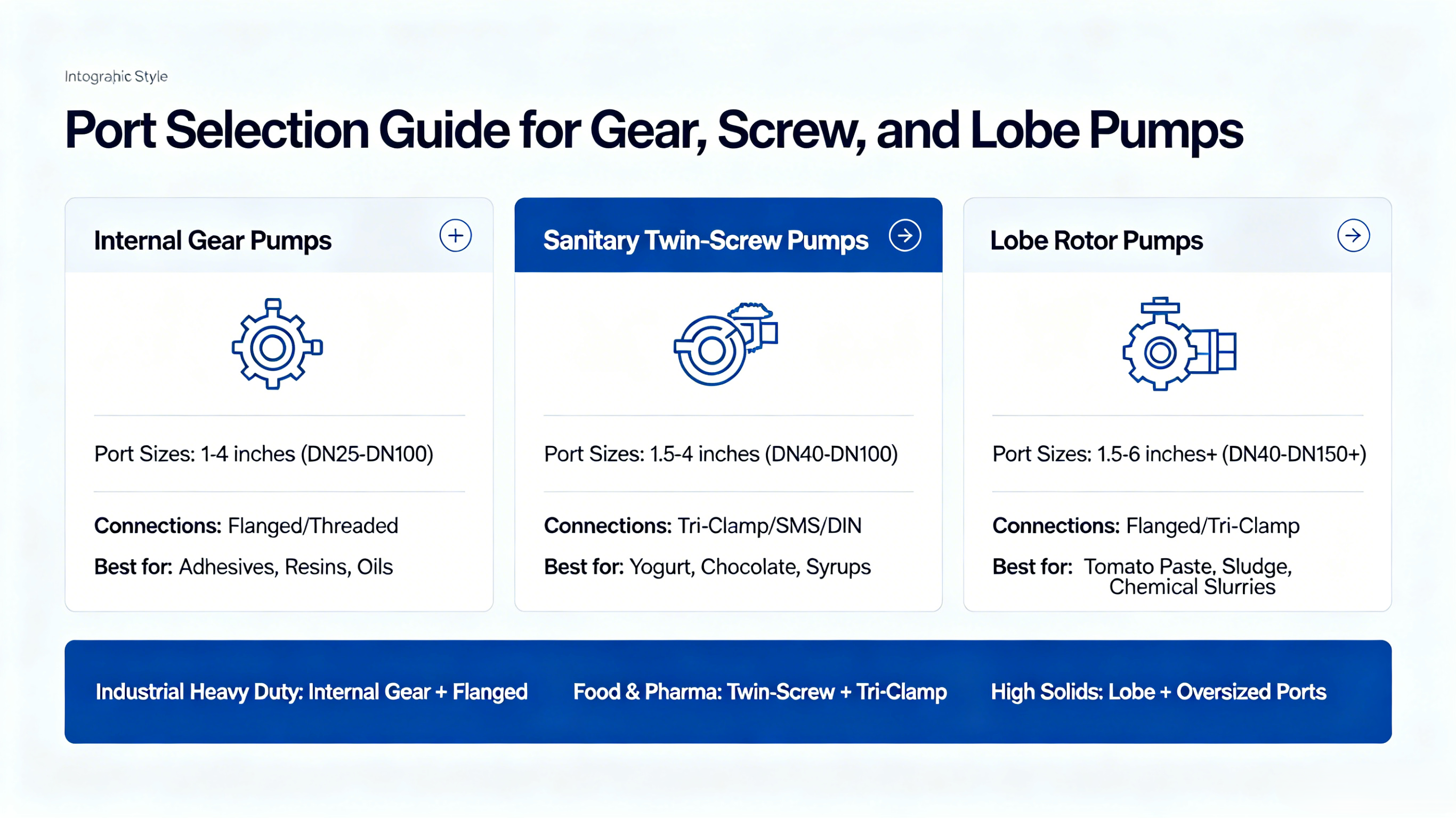
Whether you use a Gerotor-style internal gear pump for steady factory transfer or a barrel-drum type submerged gear pump to empty thick chemical drums, port selection is all about sealing and pressure resistance. Typical port sizes commonly range from 1 inch up to 4 inches (DN25 to DN100), with common connection types being flanged or threaded ports. These pumps are built for heavy, viscous industrial fluids like adhesives, resins, oils, and polymers. Because industrial resins and oils are highly viscous, these pumps must run at slower speeds. To prevent cavitation, we highly recommend utilizing oversized suction lines and heavy-duty ANSI or DIN flanged ports. Flanges offer a rock-solid, leak-free seal that handles high fluid thickness and heavy industrial pressure perfectly.
3. Port Selection for Sanitary Twin-Screw Pumps
Sanitary twin-screw pumps are high-end machines designed for the food, beverage, dairy, and pharmaceutical industries. They handle product transfer at low speeds and Clean-in-Place (CIP) cleaning at ultra-high speeds. Typical port sizes commonly range from 1.5 inches to 4 inches (DN40 to DN100), with common connection types being hygienic Tri-Clamp, SMS, or DIN sanitary threads. Their best applications include yogurt, chocolate, syrups, pharmaceutical creams, and CIP fluids. In hygienic environments, bacteria growth is your worst enemy. Standard industrial threads or flanged crevices are illegal because food can trap inside them. You must choose Sanitary Tri-Clamp ports. Tri-clamps ensure a completely smooth internal profile with zero 'dead zones' or crevices, and they are incredibly easy to dismantle by hand for manual inspection.
4. Port Selection for Lobe Rotor Pumps (Split & Monoblock Types)
Lobe pumps are the ultimate choice for handling fluids with large, delicate solids (like fruit pieces or wastewater sludge) without damaging them. This category includes split-type lobe pumps with separate gearboxes and compact monoblock lobe pumps. Typical port sizes range from 1.5 inches to 6 inches or larger (DN40 to DN150+), with common connection types offering dual availability: industrial versions use flanges, while sanitary versions use Tri-clamps. Their best applications include tomato paste with seeds, sludge, chemical slurries, and biological fluids. If your fluid contains solids, you need a much larger inlet and outlet port size. A wide port allows large particles to pass through without choking the pump entrance. For food-grade lobe pumps, stick with Tri-clamps; for municipal wastewater sludge, heavy flanges are the gold standard.
Summary Guide: Matching Ports to Your Fluid
To make your buying decision easier, use this quick checklist before placing your order: Industrial Heavy Duty: Moving glue, polymer, or resin? Choose an Internal Gear Pump with Flanged ports to handle heavy pressure. Food & Pharma Dual Duty: Moving yogurt or chocolate, plus high-speed CIP cleaning? Choose a Sanitary Twin-Screw Pump with Tri-Clamp ports for perfect hygiene. High Solids & Slurries: Moving large particles or heavy chemical sludge? Choose a Lobe Rotor Pump with oversized ports to let solids pass safely. At our facility, we customize port sizes and connection types (ANSI, DIN, JIS, Tri-Clamp) to match your existing factory piping seamlessly. Don't let a bad port selection ruin your pump’s efficiency. Reach out to our engineering team today, and let's configure the perfect pump ports for your system.