
English
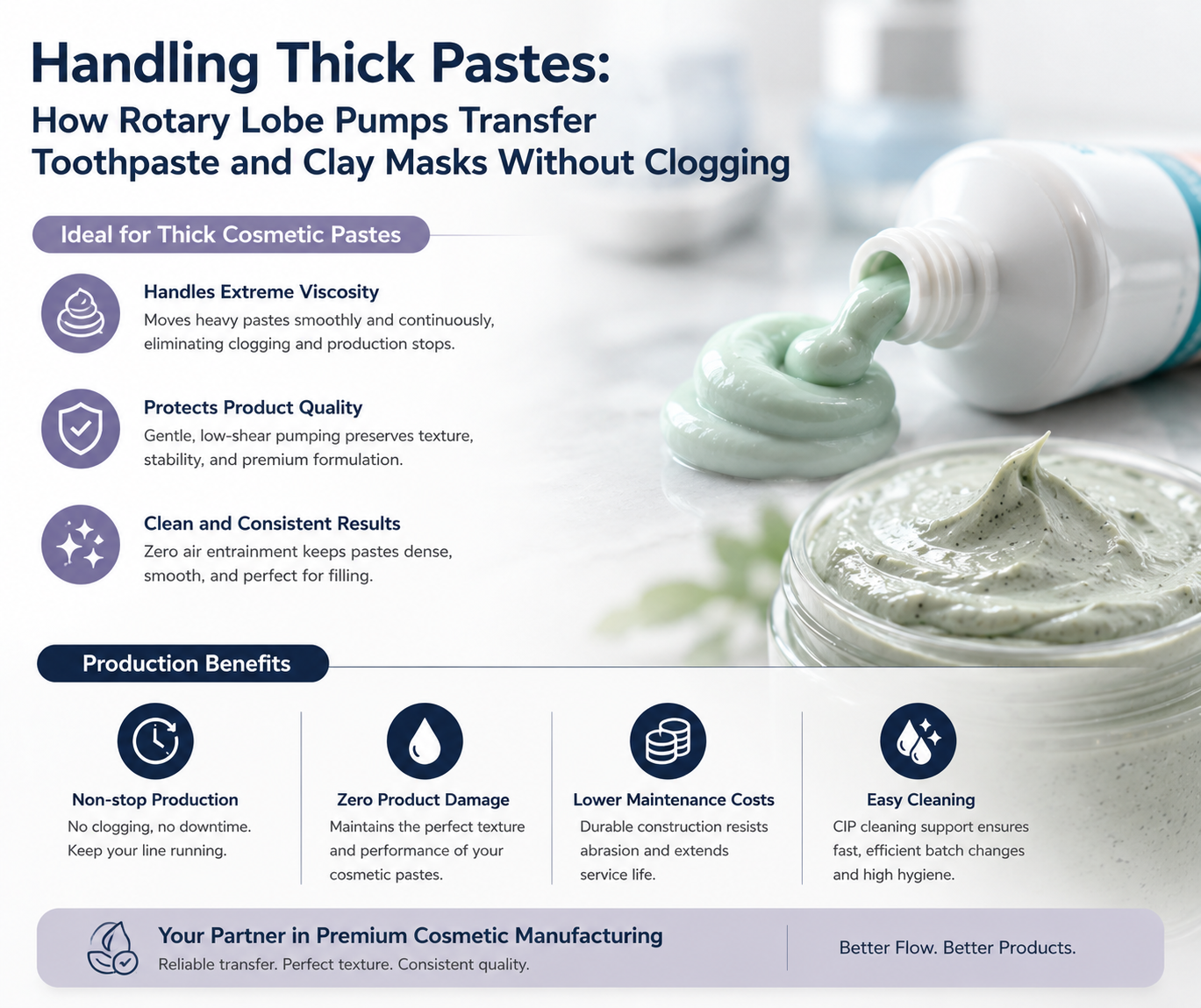
Pump clogging is a major challenge for cosmetic production managers. When a production line transfers thick toothpaste, clay masks, or heavy cream cleansers, traditional pumps often fail.
A single blockage forces operators to stop the entire line and disassemble the pump head. This sudden downtime leads to hours of lost production, higher labor costs, and a direct hit to the factory's bottom line.
Standard centrifugal pumps rely on high speeds and often stall when handling dense, sticky fluids. They cannot provide the continuous power needed to move high-viscosity formulations efficiently.
Industrial rotary lobe pumps are engineered to handle the heaviest cosmetic pastes without blockages. They use a positive displacement design to ensure uninterrupted production flow.
Pumping high-viscosity cosmetics requires a low-shear approach to maintain product quality. High-speed impeller pumps can break down binder systems, separate fine powders from liquids, or whip air into the mixture.
Rotary lobe pumps operate at low rotational speeds. Each lobe rotates smoothly without chopping or agitating the product. This low-shear fluid transfer ensures that premium cosmetic formulations preserve their exact rheological properties, density, and viscosity from the mixing tank to the filling line.
Toothpaste and clay masks contain difficult materials that can destroy ordinary pumps. These specialized lobe pumps include advanced features to withstand harsh production environments:
Silica in toothpaste and natural mud in clay masks are highly abrasive. Standard pump internals wear out within months. High-efficiency lobe pumps utilize hardened 316L stainless steel to resist wear, extend service intervals, and cut maintenance budgets.
Air bubbles ruin the appearance of premium creams and pastes. The smooth, gentle action of the rotors prevents air from getting trapped in the fluid. This creates a perfectly dense, uniform paste ready for precise tube filling.
To speed up batch changeovers, these pumps support full Clean-in-Place (CIP) protocols. Factories can clean the pump automatically between different product runs without manual disassembly, maximizing daily throughput.
Industrial rotary lobe pumps are available in close-coupled and baseplate-mounted configurations. These versatile designs allow the equipment to integrate seamlessly into existing factory layouts without requiring a redesign of the facility. Switching to low-shear lobe pumps delivers uninterrupted production, protects delicate formulas, and lowers the total cost of ownership.