When you're sourcing a positive displacement pump for your production line, the term 'Speed Range' isn't just a number on a datasheet—it's the heartbeat of your pumping system. As an experienced manufacturer of close-coupled and baseplate-mounted rotary lobe pumps, I know that getting this parameter right can mean the difference between smooth, profitable operations and costly downtime. Let me walk you through the technical details that matter most to you as a buyer.
Defining the Speed Range (RPM)
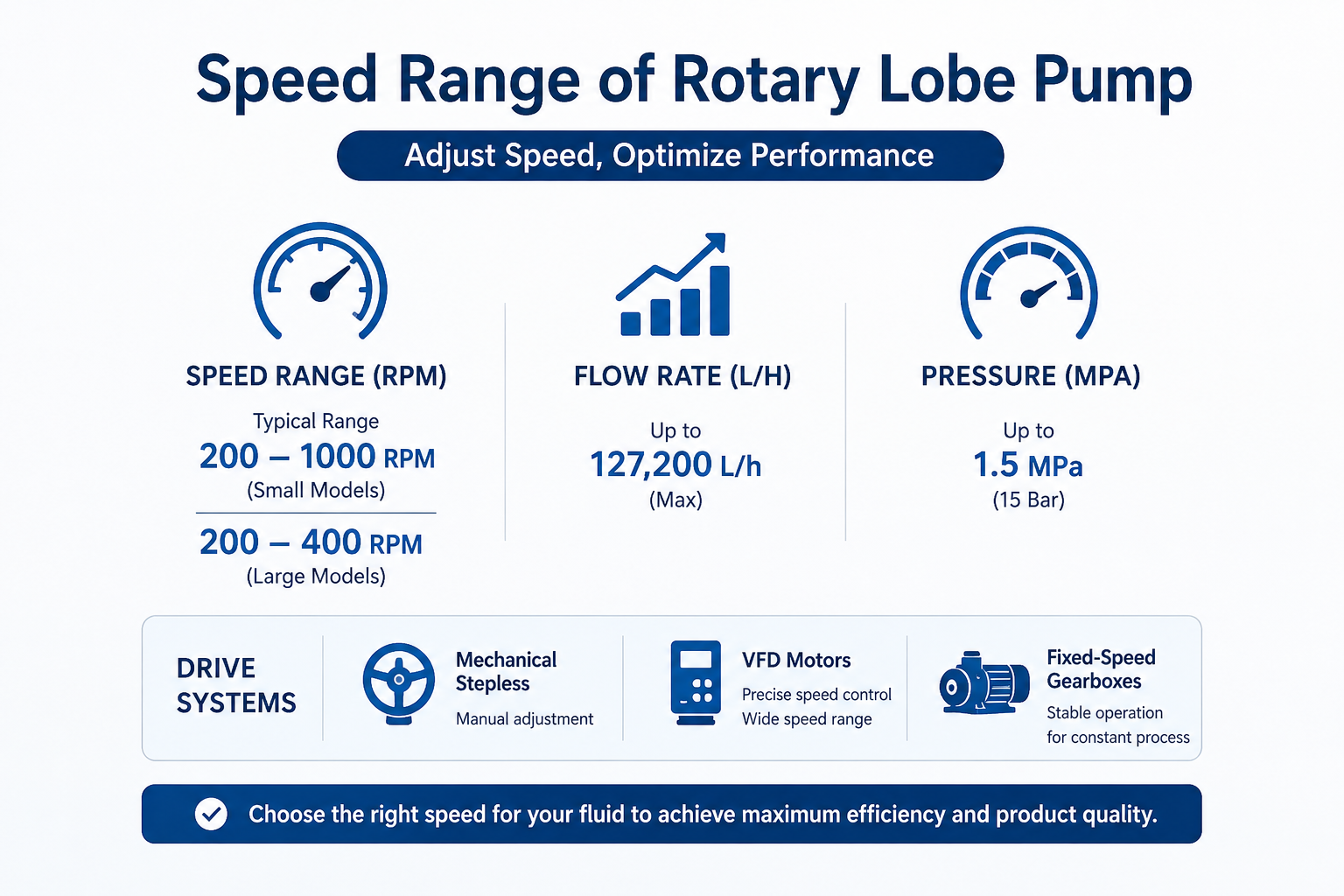
The speed range refers to the minimum and maximum rotational speeds at which a rotary lobe pump can safely and efficiently operate. It is universally measured in RPM (Rotations Per Minute). Unlike centrifugal pumps that usually run at a single, high fixed speed (such as 2900 RPM), rotary lobe pumps operate at much lower, adjustable speeds. According to standard industrial data, a versatile speed range typically spans from 200 RPM up to 1000 RPM for smaller models, and from 200 RPM to 400 RPM for larger, heavy-duty models. This flexibility is what makes them ideal for handling a wide variety of fluids—from water-thin solvents to thick, sticky pastes.
Why Speed Adjustment is Critical for Lobe Pumps
Rotary lobe pumps are positive displacement pumps. This means that the flow rate is directly proportional to the rotational speed. However, adjusting the speed range is not just about changing the output volume. It is primarily about adapting to fluid viscosity and protecting product integrity:
- Handling High Viscosity: Thick fluids like chocolate, honey, toothpaste, or heavy sludge cannot flow quickly into the pump head. To prevent cavitation and incomplete filling, the pump must operate at a lower speed range. For example, larger frame sizes are intentionally limited to a max speed of 400 RPM or 500 RPM to ensure high-viscosity pastes are transferred smoothly without damaging the pump internals.
- Protecting Sensitive Products: High speeds create high shear forces. If you pump delicate products like fruit jams with whole berries, yogurt, or bio-plasma at high speeds, you will destroy their physical structure. Lowering the speed towards 200 RPM ensures gentle, low-shear fluid transfer that keeps your product quality intact—which is essential for food, pharmaceutical, and biotech applications.
- Handling Thin Liquids: For low-viscosity fluids like beer, water, or light solvents, smaller pumps can safely operate at their maximum speed range of 1000 RPM to achieve peak flow rates. This gives you the versatility to handle seasonal changes in production without needing a separate pump.
Speed Range vs. Flow Rate and Pressure
The choice of your speed range directly dictates the output capacity and pressure of your fluid system:
- Flow Rate (L/h): At zero backpressure (free discharge), the flow rate scales perfectly with the RPM. For small-sized pumps operating between 200-1000 RPM, the flow rate can range from 330 L/h to 7,000 L/h. For massive industrial applications running at 200-400 RPM, the maximum flow rate can reach an impressive 127,200 L/h. This scalability allows you to fine-tune your production throughput without oversizing the motor.
- Pressure (MPa): Operating at the correct, optimized speed allows the pump to stably maintain high discharge pressures, generally ranging from 0.6 MPa up to 1.5 MPa (6 Bar to 15 Bar), depending on the frame size and motor power (from 0.55 kW to 37 kW). A well-matched speed range ensures you don't waste energy or stress the seals and bearings.
Common Drive Systems for Speed Control
To achieve the ideal speed range, manufacturers use different drive configurations to control the rotary lobe pump. The three standard setups include:
- Mechanical Stepless Speed Regulators: This system allows operators to manually turn a handwheel on the gearbox to adjust the RPM. It is highly reliable for workshops that only need occasional flow adjustments. It's a cost-effective solution for processes where viscosity changes slowly.
- VFD (Variable Frequency Drive) Motors: This is the most advanced option. By pairing a standard or 6-pole motor with an electronic inverter, you can digitally adjust the speed range from a central control panel. It offers a wide speed range, precise accuracy, and high automation. This is my top recommendation for plants that want to integrate with PLC systems or need rapid changeovers.
- Fixed-Speed Gearboxes: The pump runs at one constant, optimized speed. This is ideal for production lines where the fluid properties and required flow rate never change. It's robust, low-maintenance, and perfect for long-run operations like wastewater treatment or bulk ingredient transfer.
Conclusion
The speed range of a rotary lobe pump is not a fixed number for every job. It must be carefully matched to your fluid's thickness, temperature, and sensitivity. Choosing a professional manufacturer that offers versatile drive options ensures your pump runs at its highest efficiency with the longest possible service life. When you work with us, we don't just sell you a pump—we help you select the exact speed range, drive system, and configuration to maximize your return on investment. Contact our team today to discuss your application, and let's build a solution that keeps your production line running smoothly year after year.