
English
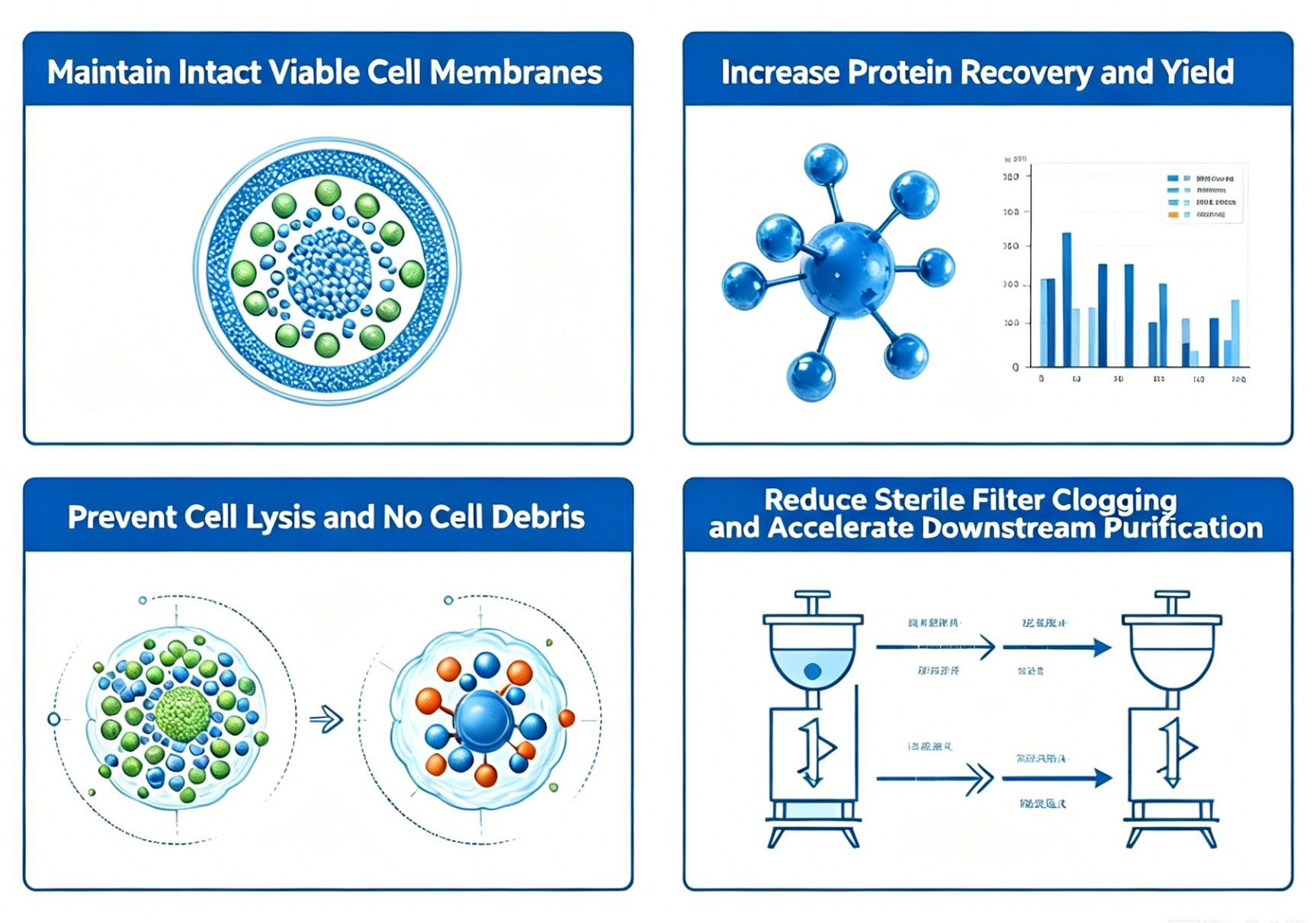
Bio-manufacturing processes—including harvesting monoclonal antibodies (mAbs), cultivating viral vectors for gene therapies, and producing recombinant proteins—require precise fluid handling. In biopharmaceutical upstream and downstream lines, the mechanical transfer of biological media represents a critical process vulnerability.
Conventional high-speed centrifugal pumps generate destructive fluid dynamics when applied to living cell cultures. Living cell matrices are inherently shear-sensitive. When cells encounter high rotational velocities and turbulent fluid friction inside a standard pump, mechanical stress tears the fragile cell membranes apart.
This process, known as cell lysis, releases intracellular contents, proteases, and host cell DNA directly into the product stream. Cell rupture compromises harvest yields, escalates downstream filtration and chromatography purification costs, and risks regulatory audit failures under FDA or EU Annex 1 compliance. Protecting structural cellular integrity is a strict commercial and technical requirement.
Hygienic rotary lobe pumps eliminate mechanical cell shear damage by utilizing low-speed positive displacement principles instead of high-velocity kinetic force to transport biological media.
To satisfy strict global medical validation and sterility benchmarks, low-speed pharmaceutical lobe pumps incorporate specific material and mechanical engineering standards:
All fluid-contacting pump components are machined from premium 316L stainless steel. Interior pumping chambers undergo controlled electropolishing to reach a roughness average (Ra) under 0.4 microns. This mirror finish stops chemical binding and prevents bacterial biofilms or cellular debris from adhering to the metal walls.
Cross-contamination and biological carryover between production batches must be completely eliminated. The pump head features a self-draining internal geometry with zero dead corners or blind spots. The pump casing fully withstands automated Clean-in-Place (CIP) chemical flushes and high-temperature Sterilize-in-Place (SIP) steam cycles up to 140°C without mechanical distortion or loss of clearance tolerances.
Upgrading to low-speed sanitary rotary lobe pumps delivers tangible operational improvements to cell culture and purification lines:
Pharmaceutical-grade lobe pumps are engineered in two mounting layouts to accommodate diverse processing plant footprints. Close-coupled configurations eliminate separate couplings and guards, offering a compact footprint for integration into mobile filtration skids, chromatography systems, and bioreactor feed loops. Baseplate-mounted models utilize a heavy-duty bedplate and separate coupling, designed for continuous high-pressure bulk media transfer lines. Both mounting formats integrate into existing stainless steel piping networks, allowing biopharma plants to streamline regulatory validation audits.