
English
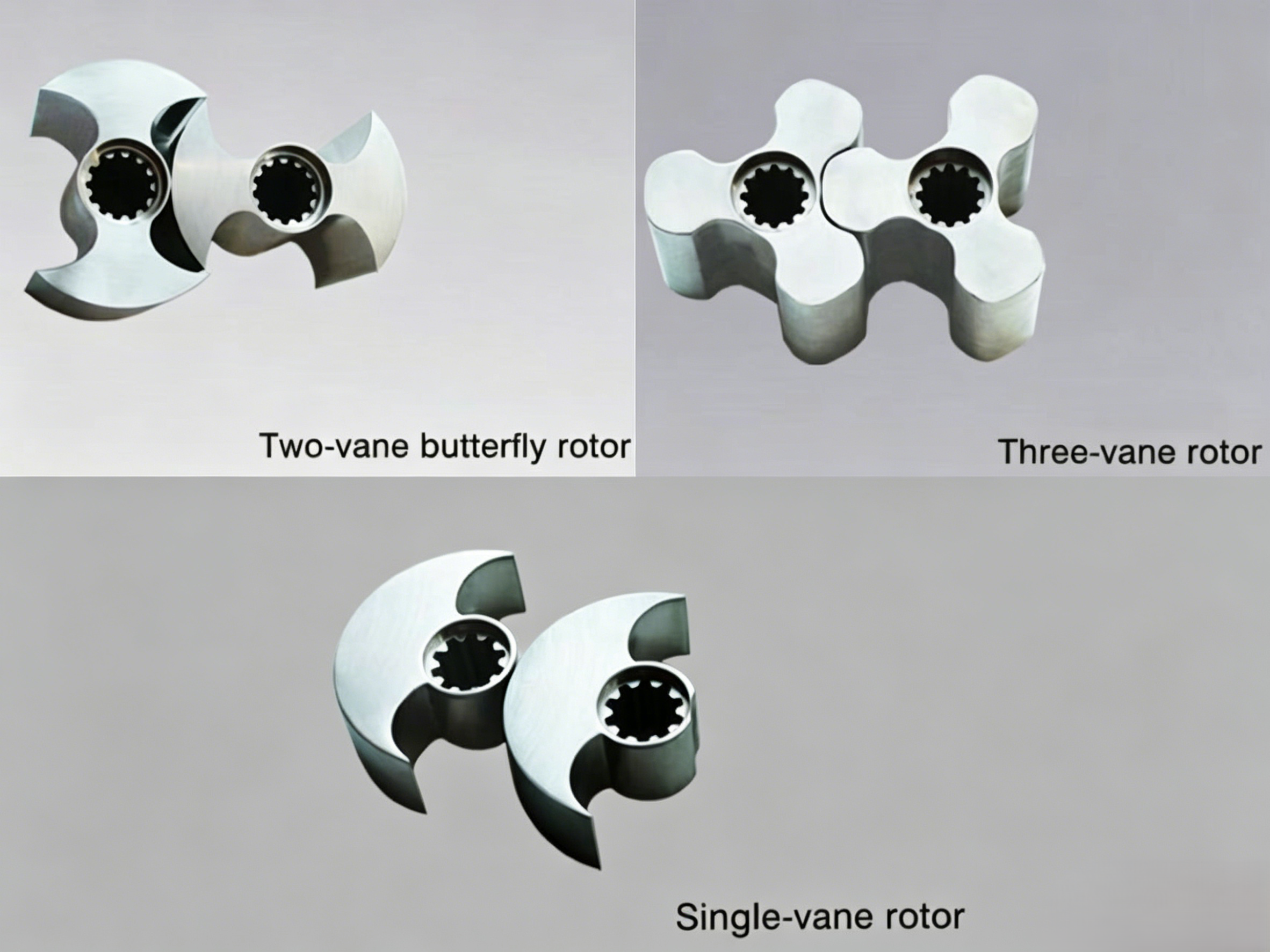
As a seasoned manufacturer of Close-Coupled Rotary Lobe Pumps and Baseplate Mounted Rotary Lobe Pumps, we understand that the rotor is the heart of your pumping system. Choosing the wrong rotor can lead to costly downtime, product damage, and inefficient operation. That is why we have created this expert guide to help you make the right decision for your specific application.
Three-Vane Rotor (Tri-Lobe) — This is the workhorse of the industry. With three smooth lobes arranged like a cloverleaf, it delivers extremely low pulsation, making it ideal for shear-sensitive fluids. If you are pumping dairy products, fine chemicals, or cream-like liquids, this rotor will give you a gentle, steady flow with minimal vibration. It handles small particles up to 10 mm with ease, and its balanced design reduces wear on seals and bearings. For food-grade and pharmaceutical applications, this is often the safest choice.
Butterfly Rotor (Two-Vane) — Our butterfly rotor is the versatile all-rounder. Its unique wing-like shape provides a perfect balance between particle handling and pumping efficiency. It can handle soft solids such as fruit pieces, seeds, and vegetable chunks up to 25 mm without crushing them. This makes it excellent for food processing (jams, sauces, soups) and daily chemical production (lotions with soft beads). The medium pulsation level is acceptable for most non-critical flows, and it offers better self-priming capabilities than the three-vane design.
Single-Vane Rotor (Single-Lobe) — When you need to move big, heavy solids, nothing beats the single-vane rotor. Its single curved lobe creates a massive internal cavity that allows large debris to pass through without jamming or damaging the pump. It is the go-to choice for wastewater treatment plants handling thick sludge, for food factories processing stews or whole fruit, and for applications where high viscosity fluids contain large chunks (up to 50 mm). Be aware that it has higher pulsation, so a pulsation dampener may be needed for sensitive downstream equipment.
Why Your Choice Matters — Many buyers make the mistake of selecting a rotor based only on price. But the wrong rotor will cost you more in the long run through higher energy consumption, frequent repairs, and product waste. Our rotors are precision-machined from stainless steel or high-grade alloys, with optional rubber or polyurethane coatings for abrasive fluids. We also offer custom clearances to match your exact viscosity and temperature requirements.
Get Expert Help Today — Still not sure which rotor is best for your close-coupled or baseplate mounted pump? Our engineering team has over 20 years of experience helping clients in food, dairy, chemical, and waste treatment industries. We can review your fluid properties, solids content, and pressure needs to recommend the optimal rotor in minutes. Contact us now for free technical support, a detailed comparison chart, and a competitive quote. Don't let a wrong rotor slow down your production—choose the right one from the start.