
English
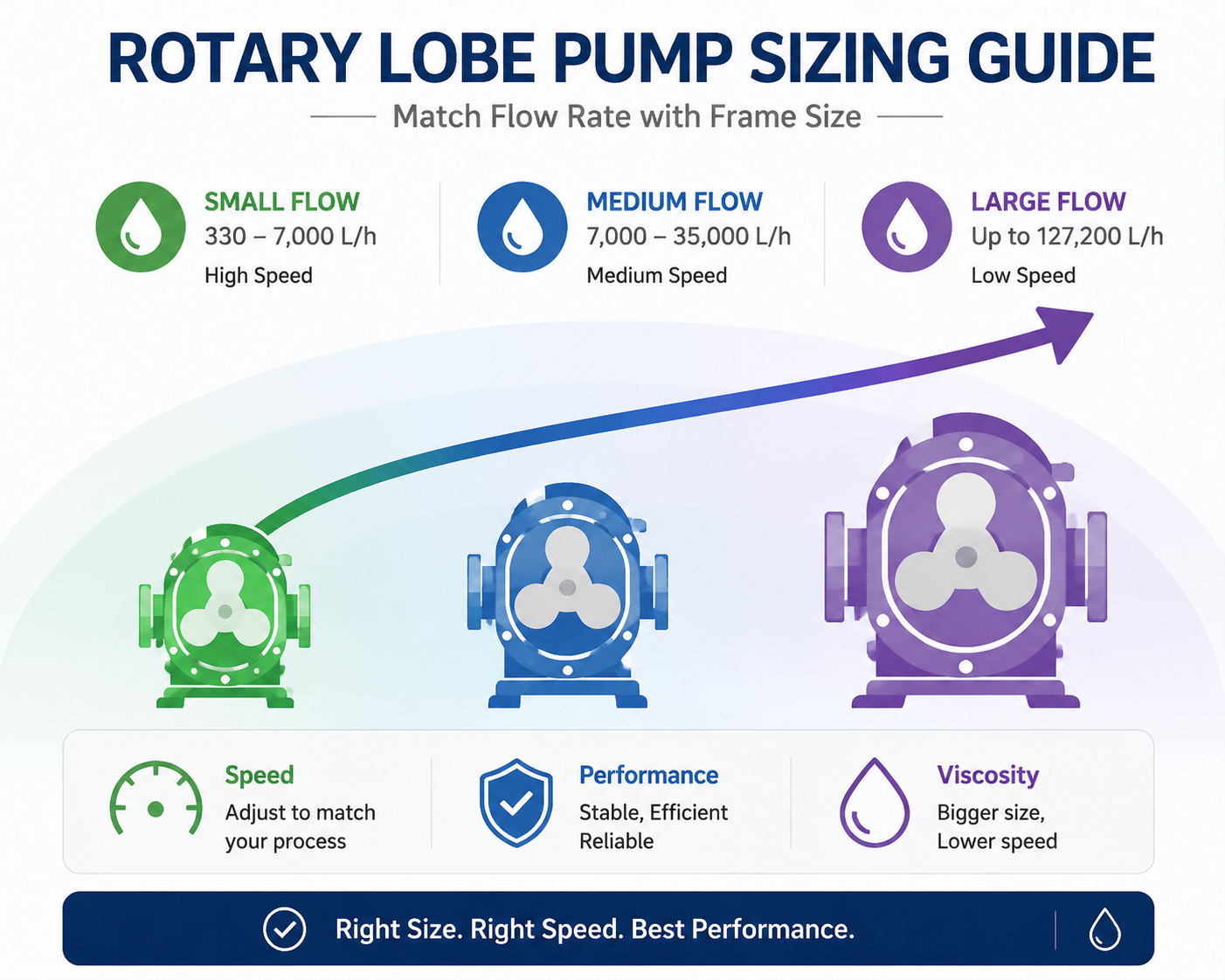
When you're in the market for a sanitary rotary lobe pump, the first question that usually pops up is: 'We need a certain hourly output—what frame size should I go with?' Let's be honest—nobody wants to overspend on a pump that's too big or risk downtime with one that's undersized. That's why understanding the relationship between flow rate and frame size is crucial for making a smart purchase.
At the heart of every lobe pump lies a simple concept: Displacement per Revolution (measured in L/rev). Each rotation pushes a fixed volume of liquid from inlet to outlet. A bigger frame means larger rotors and cavities, which translates to higher displacement per revolution. The basic formula is: Flow Rate (L/h) = Displacement per Revolution × RPM × 60. Easy, right? But the trick is matching that to your actual production needs.
Our TR and TRA series cover frame sizes from 05 to 15, giving you a broad range to pick from. Here's how we break it down:
Small Flow Needs (330 – 7,000 L/h): Perfect for small-to-medium food labs, cosmetic lines, or craft breweries. These compact frames run at 200–1000 RPM and deliver precise, low-volume flows without breaking a sweat. If you're handling delicate batches, this is your sweet spot.
Medium Flow Needs (7,000 – 35,000 L/h): When your line demands tens of thousands of liters per hour, you need more robust support. Medium frames operate at 200–500 RPM, balancing high output with longevity. Lower speeds mean less wear—your pump lasts longer, and you save on maintenance costs.
Large Industrial Flow Needs (Up to 127,200 L/h): Think mega breweries, dairy giants, or wastewater plants. Our size 15 frame can push an impressive 127,200 L/h even at a leisurely 200–400 RPM. That's raw power without the high-speed stress.
But here's the kicker: Fluid Viscosity Changes Everything. The spec sheet numbers assume you're pumping water-like thin liquids at zero backpressure. In real life, you might be dealing with chocolate, syrup, or fruit puree—thick stuff that moves slowly. If you pick a small frame and crank up the RPM to hit your flow target, you'll face incomplete filling and cavitation damage. The golden rule? Go bigger and slower. Choose a larger frame size, drop the RPM, and let gravity do its job.
Your Next Step: Don't guess—match. Send us your target flow rate and viscosity, and we'll give you a precise sizing report. No fluff, just engineering that works for your factory floor. Let's get your pump right the first time.