
English
When comparing pump specifications, many buyers focus only on maximum flow rate. However, for positive displacement pumps, there is a much more fundamental parameter: Displacement per Revolution (often called displacement volume). Whether you operate gear, screw, or lobe pumps, this fixed geometric value is the true DNA of your pump. As a premier pump manufacturer, we created this guide to explain how displacement per revolution dictates your flow, system efficiency, and final pump selection using our standard industrial metric: L/rev (Liters per Revolution).
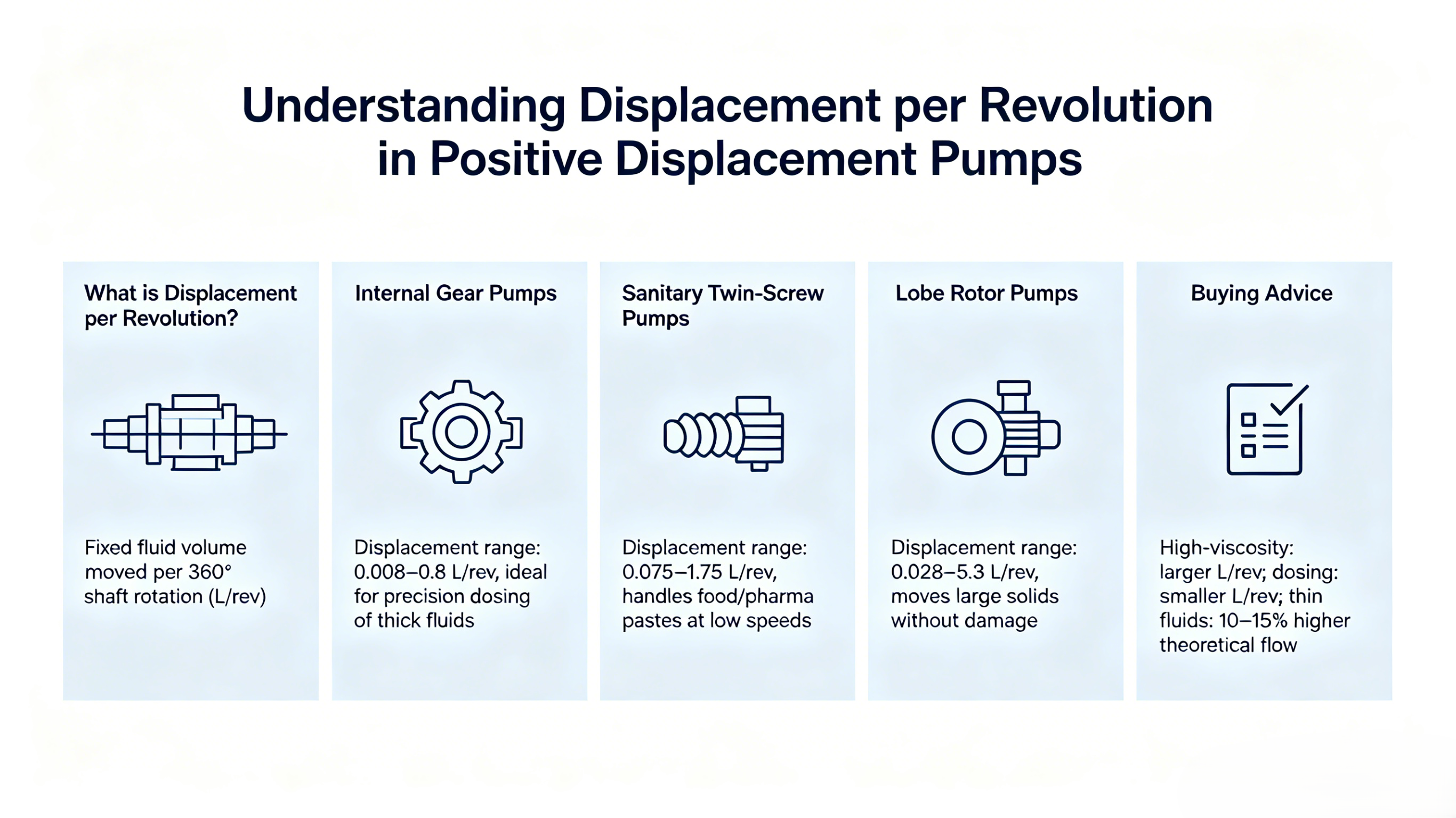
What is Displacement per Revolution? Displacement per revolution is the exact volume of fluid a pump traps and moves forward during one single, 360-degree rotation of its shafts. Unlike centrifugal pumps, where flow changes wildly with pipe resistance, positive displacement pumps push a fixed pocket of fluid every time they spin. For high-capacity and precision engineering, we measure this displacement volume in L/rev (Liters per Revolution). The math is straightforward: your theoretical flow rate in Liters per Minute (L/min) equals displacement per revolution (L/rev) multiplied by pump speed (RPM). For example, a pump with a displacement of 0.1 L/rev running at 1,000 RPM will theoretically move exactly 100 Liters of fluid per minute. This simple formula is the foundation of accurate pump sizing.
Displacement in Internal Gear Pumps: Our internal gear pumps feature a compact gear-inside-a-gear design, where the spaces between the gear teeth determine the exact displacement in L/rev. We engineer these pumps with a precise displacement range from 0.008 L/rev to 0.8 L/rev. Because these pumps have a fixed displacement, they are excellent for precision industrial dosing or steady transfer of heavy resins, glues, and oils. Since these thick fluids seal the gear clearances, you can achieve an actual flow rate that is nearly 100% of your theoretical L/rev calculation. This means less energy waste and more predictable output for your production line.
Displacement in Sanitary Twin-Screw Pumps: Our sanitary twin-screw pumps utilize two intermeshing, non-contacting screws. The pitch and depth of the screw profiles form the displacement cavities. We manufacture these pumps with a versatile displacement range from 0.075 L/rev to 1.75 L/rev. Twin-screw pumps are known for high flexibility. Because our pumps offer a large displacement up to 1.75 L/rev, they can move massive volumes of food-grade pastes, chocolate, or pharmaceutical creams gently at very low speeds to prevent shearing. When you increase the RPM, that same displacement allows the pump to generate the high-velocity flows needed for Clean-in-Place flushing. This dual capability saves you from buying separate pumps for transfer and cleaning.
Displacement in Lobe Rotor Pumps: Our heavy-duty lobe rotor pumps use synchronized rubber or stainless steel lobes. The massive open pockets between the lobes create the displacement volume. We design these pumps with an ultra-wide displacement range from 0.028 L/rev to 5.3 L/rev. This huge displacement cavity allows large, delicate solids—such as whole fruit pieces, berries, or thick chemical slurries—to enter the pump head easily and pass through safely without being crushed, chopped, or damaging your line. If you handle shear-sensitive or particulate-laden fluids, our lobe pumps with high L/rev values are your best bet for maintaining product integrity and reducing downtime.
Buying Advice: Choosing the Right L/rev Specification: To choose the perfect pump size for your production line, do not just look at the maximum flow rate on the spec sheet. Follow these manufacturer rules. For high-viscosity fluids, choose a pump with a larger L/rev displacement. This allows you to run the pump at lower speeds (lower RPM) to achieve your target flow, preventing fluid cavitation and machinery wear. For dosing and metering, choose a smaller, precise displacement from our 0.008 L/rev options. Combined with a variable frequency drive, this gives you perfect, drop-by-drop flow control. Factor in slip: if your fluid is very thin like water or solvents, some fluid will slip backward inside the pump. Always pick an L/rev spec that gives you a theoretical flow 10% to 15% higher than your actual required production capacity. At our engineering facility, we precisely configure displacement per revolution across our entire gear, screw, and lobe pump lines to match your exact factory layout. Contact our technical team today to find the perfect L/rev specification for your process fluid and ensure your system runs at peak efficiency from day one.