
English
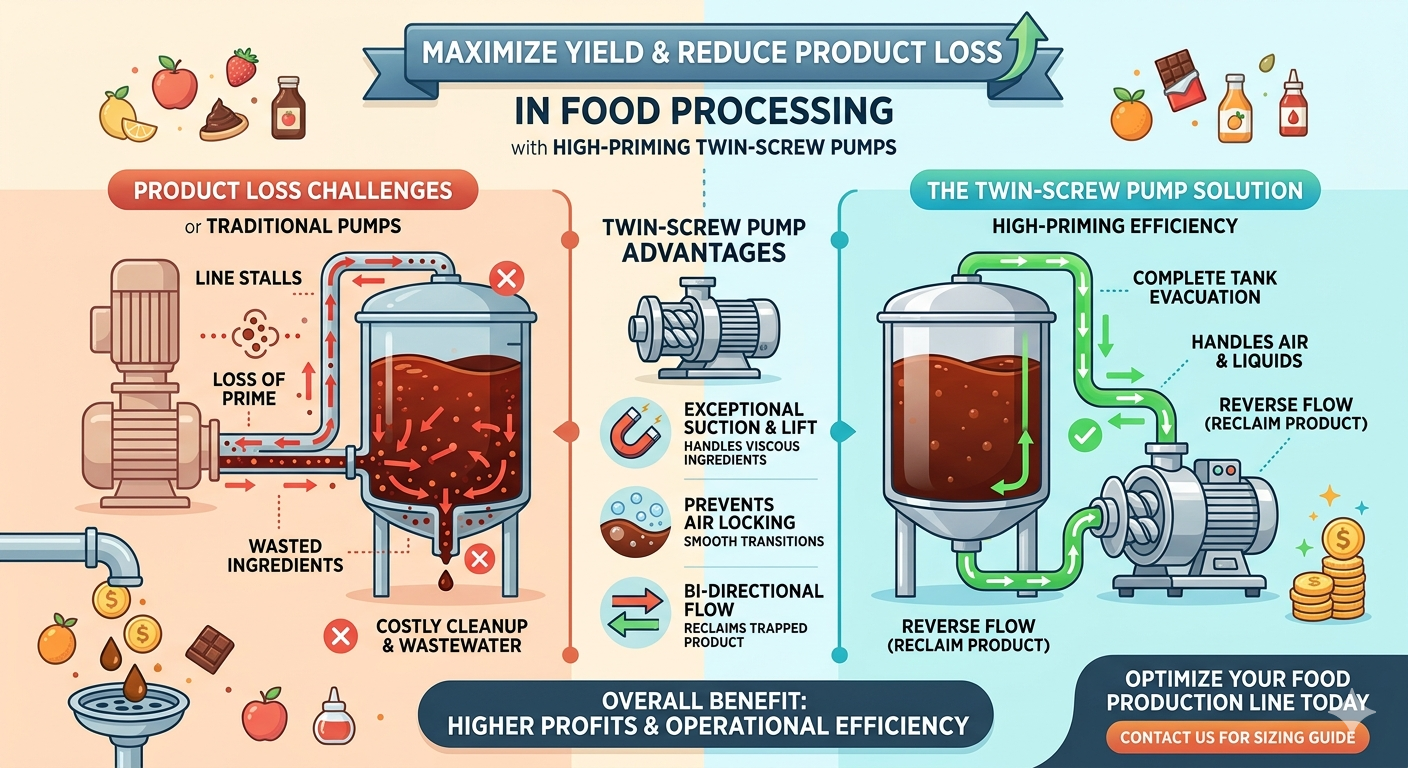
In high-volume food processing plants, every drop of product left behind in mixing tanks, transfer pipes, or bulk containers represents a direct hit to your bottom line. Highly viscous ingredients like fruit concentrates, chocolate slurries, sauces, and dough blends are notorious for sticking to equipment surfaces, leading to costly raw material waste and lengthy flush cycles.
Traditional centrifugal or rotary lobe pumps often struggle to evacuate tanks completely due to their limited suction capabilities. This is where upgrading your food transfer equipment to a Sanitary Twin-Screw Pump becomes a game-changing solution for operational efficiency and profitability.
Here is a detailed breakdown of how leveraging the high-priming capabilities of a sanitary twin-screw pump can drastically reduce product loss in your food processing facility.
Product loss during batch changeovers or tank evacuations is often a hidden cost. When a transfer pump loses its prime before a tank is completely empty, several issues occur:
By integrating a high-priming food-grade twin-screw pump into your production line, you can actively pull product from the very bottom of the tank, converting potential waste back into sellable yield.
The mechanical architecture of a sanitary twin-screw pump gives it a definitive edge over alternative technologies when it comes to suction lift and priming power.
Exceptional Vacuum Generation: Unlike lobe pumps that require liquid to seal the pumping chamber initially, twin-screw pumps utilize tight internal tolerances and a continuous axial movement. This creates an extremely high volumetric efficiency, allowing the pump to pull a deep vacuum. It can effortlessly handle dry-priming and lift fluids from deep vessels or underground sumps.
Handling Air and Liquid Simultaneously (Multi-Phase Pumping): A major bottleneck with traditional food transfer pumps is "air locking." When a tank is nearly empty, air enters the line, causing standard pumps to lose prime and stop pumping. A twin-screw pump, however, is a natural multi-phase pump. It can handle liquids with high gas content or entrained air. As the tank empties, the pump smoothly transitions from moving heavy paste to moving air, effectively acting as a line scraper to push the final remnants of the batch through the piping.
When selecting a twin-screw pump for waste-reduction solutions, look for these specific engineering standards:
Beyond reducing product loss, investing in a high-priming twin-screw pump delivers a massive return on investment (ROI) by serving a dual purpose. Traditionally, plants require a dedicated food transfer pump and a separate, high-flow CIP return pump to pull cleaning solutions out of the tanks. Because a twin-screw pump handles high-velocity thin fluids just as well as thick pastes, one single twin-screw pump does both jobs. It evacuates the product completely, and then speeds up to handle the CIP return fluid, saving you the equipment cost and footprint of a second pump.
Minimizing product loss is one of the easiest ways to boost the profit margins of your food plant. Transitioning from inefficient, line-stalling pumps to a high-priming Sanitary Twin-Screw Pump ensures maximum tank evacuation, lower wastewater costs, and faster changeovers. Optimize Your Food Production Line Today. Are you ready to eliminate raw material waste and upgrade your processing efficiency? Contact our engineering team today for a custom twin-screw pump sizing guide tailored to your specific viscosity and flow rate requirements.