
English
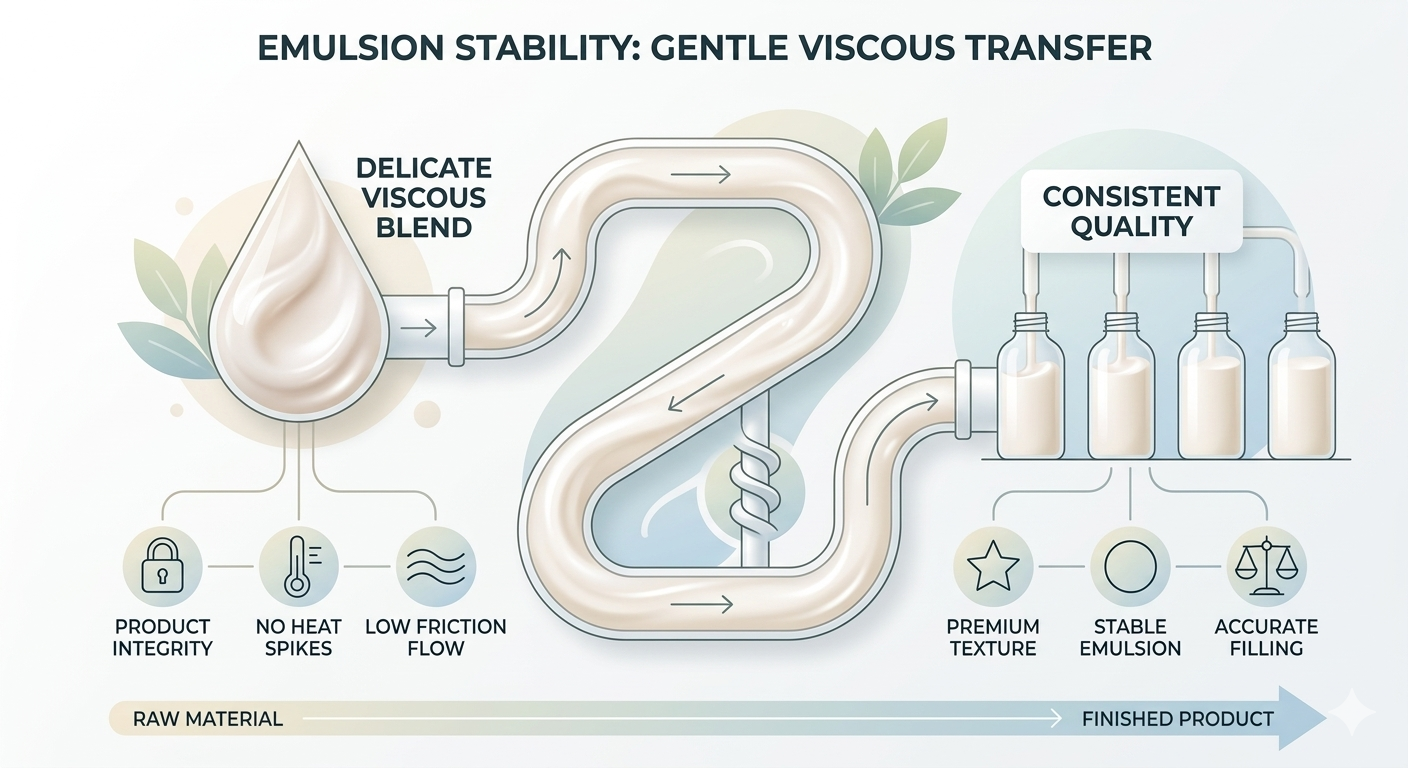
As a plant manager or production engineer in the cosmetics industry, you know that the integrity of your high-value creams and lotions is everything. Every batch represents significant investment in raw materials, R&D, and precision blending. Yet, when it's time to transfer that thick, luxurious emulsion from the mixing tank to the filling line, a hidden threat lurks in your pump room: mechanical shear. Standard centrifugal or lobe pumps can turn a premium, stable cream into a thin, watery, or separated mess in seconds. This isn't just a quality issue—it's a direct hit to your bottom line, with wasted batches, rework costs, and unhappy customers seeing oil slicks on their moisturizer.
The mechanical root cause is straightforward. Most traditional pumps rely on tight clearances and high-speed rotation to generate flow. When you force a structured emulsion through a centrifugal impeller or between tightly meshed gears, you create intense friction. This friction breaks down the delicate oil-water bonds that give your product its texture and stability. The result? Structural thinning (your thick cream runs like milk), localized heat that ruptures emulsifier bonds, and final products that separate on the shelf. Your formulation chemist spent months perfecting that feel—don't let a pump ruin it.
Enter the sanitary twin-screw pump—a dedicated solution designed from the ground up to handle sensitive, high-viscosity cosmetics without causing damage. Unlike gear or lobe pumps, the twin-screw design features counter-rotating screws that never physically touch each other. Driven by external timing gears, these screws rotate with precise, non-contacting clearances. This completely eliminates the mechanical crushing and metal-to-metal rubbing that shears delicate emulsions. The product moves gently along a linear, axial flow path—not a turbulent radial one. This means your cream or lotion is cradled inside sealed volumetric chambers, gliding smoothly from suction to discharge at low velocity.
Shear rate is directly tied to pump speed. Because twin-screw pumps deliver high volumetric output per revolution, you can move heavy creams at exceptionally low RPM. This low rotational speed drastically reduces peripheral tip speed, preventing localized heat buildup and preserving the cream's structure. Additionally, thick face creams create high flow resistance at the inlet, which can cause cavitation in standard pumps—a phenomenon that physically tears emulsions apart. Twin-screw technology features an unobstructed, straight-line suction path with low Net Positive Suction Head Required (NPSHr), ensuring smooth, uncompressed product intake even at maximum thickness.
Operationally, the benefits go beyond product protection. You get predictable quality control, with consistent viscosity and texture from first drop to last. The continuous axial displacement provides pulse-free fluid flow, preventing aeration and enabling accurate filling at packaging nozzles. And here's a bonus: the same pump handles sensitive formulations at low speeds and can ramp up to high speeds for Clean-in-Place (CIP) circulation, eliminating the need for separate CIP pumps and bypass valves. This simplifies piping layout and reduces capital costs.
For plant managers serious about protecting their brand's reputation and reducing batch waste, investing in a sanitary twin-screw pump is a straightforward decision. It replaces aggressive, damaging fluid handling with a controlled, gentle transfer solution that safeguards your product's premium quality. By addressing the mechanical root causes of emulsion breakdown, this robust equipment choice ensures reliable line performance, reduces waste, and keeps your creams and lotions exactly as they were formulated—rich, stable, and luxurious.