
English
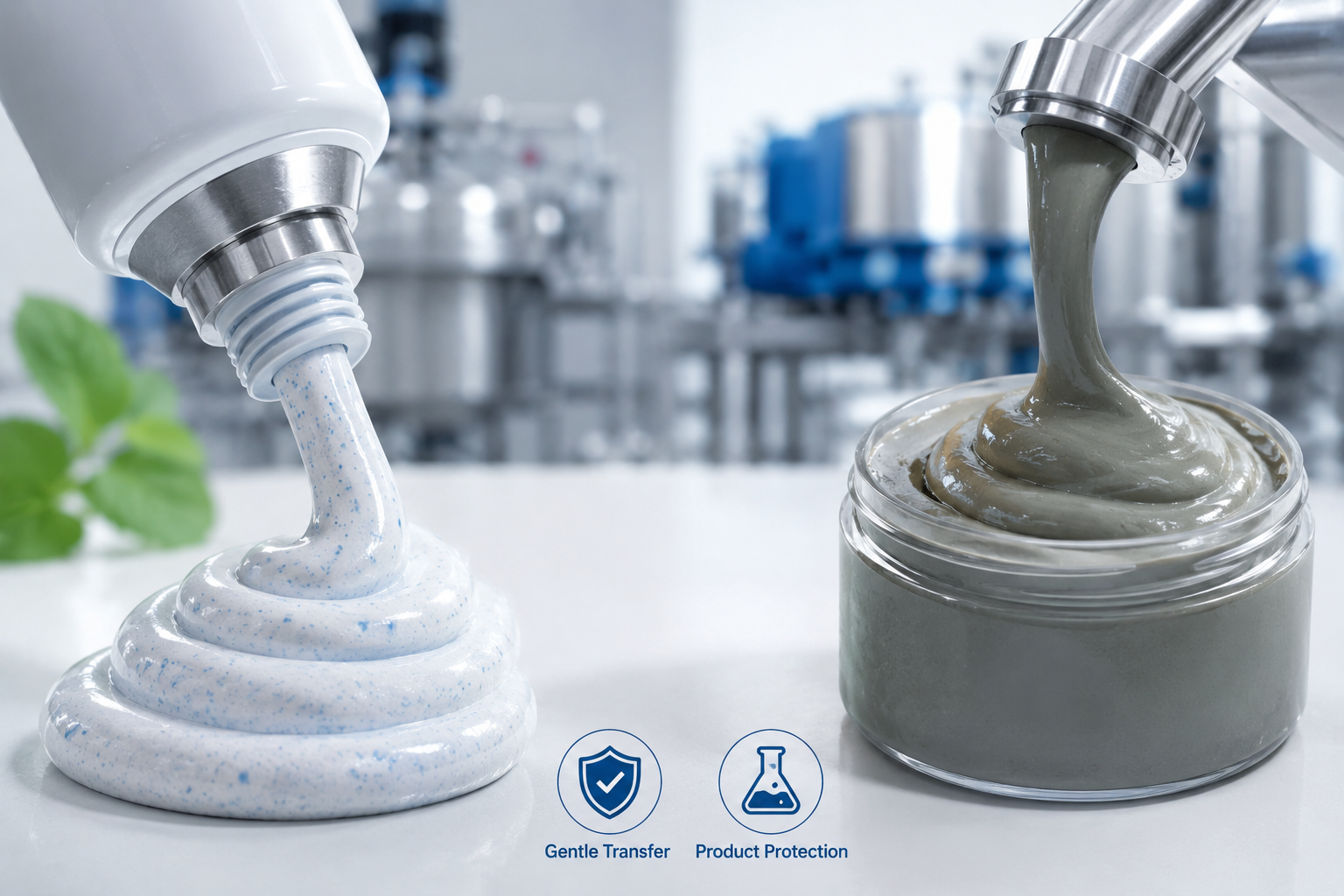
In the personal care and cosmetics industries, heavy, high-viscosity end products like toothpaste and clay masks present unique manufacturing challenges. These formulations are intentionally engineered with dense, thick, and often abrasive structures to deliver their functional benefits to consumers. However, during the final stages of production—specifically when transferring these products from mixing vessels to filling and packaging lines—their extreme viscosity makes them notoriously difficult to handle. Standard pumps often cause product structural breakdown, pocketing, or aeration. Utilizing a sanitary twin-screw pump within the process line provides a gentle, reliable, and high-efficiency solution that preserves the premium texture and quality of the final product.
The Process Challenge: Managing Dense, Non-Newtonian Formulations
Toothpaste and clay masks are classified as non-Newtonian fluids, meaning their flow behavior changes under mechanical stress. They are also heavily loaded with solids, such as calcium carbonate or natural mineral clays, which makes them vulnerable during factory processing. The risk of texture breakdown is significant: toothpaste relies on a precise balance of binders and humectants to maintain its smooth, cohesive ribbons. Clay masks require a perfectly homogeneous paste to ensure uniform skin application. Aggressive pumping or violent churning can over-shear these products, permanently thinning their body, causing them to turn runny or lose their smooth, luxurious texture. Furthermore, because these products are so thick, they do not flow easily into the suction side of a pump. This low fluid mobility often causes standard pumps to experience 'cavitation' or severe air pocketing. This introduces unwanted air bubbles into the toothpaste or mask paste, which later leads to incomplete or under-filled tubes and jars on the packaging line, forcing manufacturers to reject entire batches.
Protecting Product Quality: How Twin-Screw Processing Secures Perfection
A sanitary twin-screw pump acts as a dedicated product guardian, adapting perfectly to the heavy rheological demands of toothpaste and clay mask formulations. Its gentle continuous displacement mechanism ensures that instead of beating or compressing the thick paste, the intermeshing screws form expansive, moving cavities that gently scoop up the formulation and transport it forward along the horizontal axis. This steady, low-impact movement applies almost zero high-shear force, allowing toothpaste to retain its rich density and clay masks to keep their thick, creamy body. Moreover, the excellent suction performance of these pumps prevents air pockets: high-viscosity products tend to stick to tank walls and resist moving, but twin-screw pumps feature an exceptional vacuum capability and low net positive suction head requirements. This strong, steady suction pulls the heavy paste uniformly into the pump chamber, preventing localized cavitation, avoiding air entrainment, and keeping the final liquid completely air-free. Additionally, the pulse-free flow delivered by the continuous volumetric discharge provides a perfectly smooth, non-pulsating fluid stream directly to the filling nozzles. This steady pressure eliminates product spurting or dripping, which is critical for maintaining high-speed tube filling accuracy, clean sealing edges, and zero product waste.
Direct Benefits to the End Product and Production Yields
With this technology, manufacturers achieve flawless consumer texture: the toothpaste squeezes out in a perfect, solid ribbon, and the clay mask retains its thick, smooth spreadability without any grainy separation or thinning. Zero air bubbles in packaging means that eliminating micro-foaming and air pockets ensures every tube, jar, or pouch is filled with absolute volumetric accuracy, boosting packaging line efficiency and minimizing product rejections. Furthermore, the wear resistance against abrasive formulations is a critical advantage: toothpaste whitening agents (silica) and mineral clays are highly abrasive, but the non-contacting internal design of the twin-screw pump prevents internal metal-on-metal rubbing. This means no metallic particles can contaminate the sensitive personal care product, ensuring 100% batch purity.
Critical Processing Applications in Personal Care Factories
This technology is ideal for toothpaste packaging feed—transferring highly viscous, fluorinated, or gel-striped toothpaste from bulk holding tanks directly into automated high-speed tube filling machinery. It is also perfect for mineral clay mask transfer, moving dense, thick charcoal or bentonite clay formulations through final screening and into individual jars without drying out or separating. Additionally, it supports dense ointment and scrub delivery, handling thick cosmetic body scrubs and heavy topical salves under high discharge pressures while keeping particle distribution perfectly uniform.
Ensuring Batch-to-Batch Perfection
For manufacturers of high-viscosity personal care products, consumer perception is heavily tied to the product's weight, texture, and visual presentation. Upgrading to a sanitary twin-screw pump replaces destructive fluid handling with a smooth, continuous, and low-shear transfer process. By overcoming the challenges of extreme viscosity, air pocketing, and abrasion, this advanced processing solution protects your formulation’s integrity, elevates your production line efficiency, and ensures every single product meets the highest sensory standards.