
English
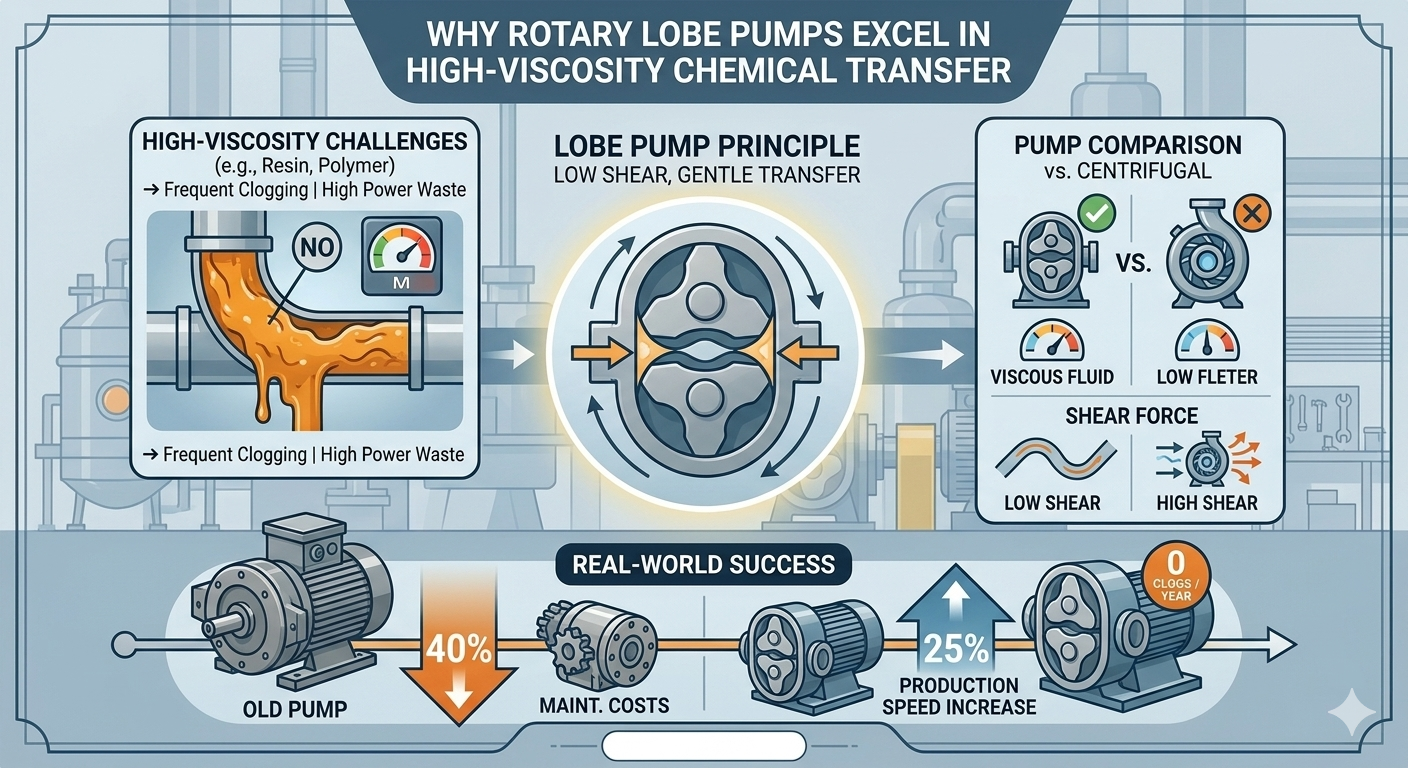
If you're a plant engineer or procurement manager in the chemical industry, you already know the headache of pumping thick fluids. Whether it's resins, adhesives, polymers, or viscous slurries, standard pump technologies often struggle to keep up. You've probably seen it happen: clogged lines, overheated motors, damaged product batches, and unplanned downtime that costs thousands. That's where the rotary lobe pump comes in as the game-changing solution.
The Core Challenges of High-Viscosity Chemical Transfer
Let's be honest about what goes wrong. First, viscous fluids like epoxy resins or polyurethane don't flow easily, causing frequent blockages in piping and pump internals. Second, centrifugal pumps lose efficiency rapidly as viscosity climbs above 1,000 cP, wasting energy and forcing you to oversize your motors. Third, shear-sensitive fluids—think latex, adhesives, or certain polymers—can be permanently damaged by aggressive pump action, ruining product quality and leading to costly rework.
Why the Rotary Lobe Pump Is the Perfect Fit
The rotary lobe pump, also known as a close-coupled or baseplate-mounted lobe pump, is built differently. Its lobes rotate in opposite directions without making internal contact, creating a positive displacement action that handles thick fluids with ease. Here's why it wins:
Comparison at a Glance: Lobe Pump vs. Centrifugal Pump
Let's put it side-by-side. For high-viscosity transfer, a centrifugal pump's performance curve plummets—flow drops, vibration increases, and cavitation risks spike. In contrast, a rotary lobe pump maintains steady flow regardless of viscosity, delivering reliable performance from startup to shutdown. When accidental dry running occurs, a centrifugal pump seizes up damaging seals and bearings; a lobe pump can tolerate short dry spells without catastrophic failure, saving you from expensive rebuilds.
Is Your Plant Ready for Better Pumping?
If you're tired of fighting with sticky chemicals, wasting power, or compromising product quality, it's time to consider a rotary lobe pump. Our team has decades of experience matching the right lobe pump—close-coupled or baseplate-mounted—to your specific viscosity and pressure requirements. We'll help you calculate the exact duty point, suggest materials of construction compatible with your chemicals, and provide a solution that pays for itself within months.
Don't let thick fluids slow you down. Contact us today for a free consultation and quote. Your plant deserves pumps that work as hard as you do.